Moon-Saturn Conjunction October 2026: Where to Look Tonight
Telescope Advisor Logo Telescope Advisor
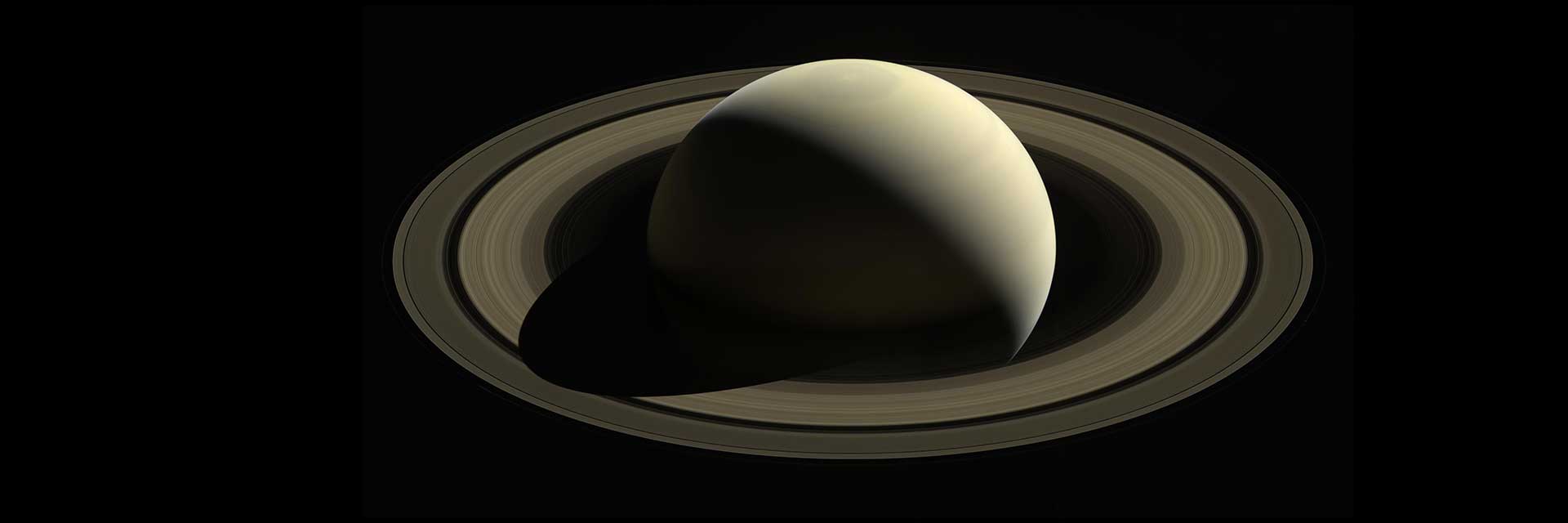
Saturn and its rings photographed by NASA's Cassini spacecraft. The ringed planet sits close to the nearly full Moon on October 23 and 24, 2026

Moon & Planet Pairing · October 23–24, 2026

Moon-Saturn Conjunction October 2026: Where to Look Tonight

The almost-full Moon sweeps past Saturn this weekend. On Friday night, October 23, the steady golden “star” to the Moon’s lower left is Saturn. By Saturday night, October 24, the Moon has jumped past it, and Saturn shines to the Moon’s right. Point any small telescope at that dot and you will see its rings, which are still tilted wide enough to show clearly, three weeks after Saturn’s opposition.

Oct 23–24Best evenings (US)
~8–10°Moon–Saturn gap after dark
+0.4Saturn magnitude
94–98%Moon illuminated
By Telescope Advisor Editorial Team | Published: | Updated: | Editorial Standards

Quick Answer: When and Where to See the Moon and Saturn

  • • Best nights: Friday, October 23 and Saturday, October 24, 2026, from about an hour after sunset until the small hours.
  • • Where to look: Low in the east-southeast at dusk. The pair climbs to the south by late evening, and Saturn is highest around 11:30 p.m. to midnight local time.
  • • Which dot is Saturn: On Oct 23 it is the steady, pale-gold point about 8° to the Moon’s lower left, roughly the width of your fist at arm’s length. On Oct 24 it sits about 9–10° to the Moon’s right.
  • • Exact conjunction: October 24 at about 17:40 UTC (1:40 p.m. EDT), when the Moon passes 6.8° north of Saturn. That moment falls in daylight for North America, so the two evenings either side are the ones to watch.
  • • October 25? By Sunday evening the Moon has moved about 23° east of Saturn, so the two are no longer a close pair. Sunday night is the eve of the full Hunter’s Moon instead.
  • • Equipment: Eyes are enough to see the pairing. Any telescope from 70mm up shows Saturn’s rings, and a Moon filter makes the 98%-lit Moon comfortable to look at.

Positions, separations, rise times and illumination were computed by Telescope Advisor from the JPL DE421 planetary ephemeris using the Skyfield library, for New York, Chicago, Denver and Los Angeles. We cross-checked them against Astronomy magazine’s October 2026 sky guide and the Royal Observatory Greenwich listings. Times are local daylight time.
Night-by-Night: How the Moon Passes Saturn

The Moon moves east against the background stars by roughly its own width every hour, about 13° per day. That is why a Moon-planet “conjunction” plays out over several evenings rather than at a single instant. Saturn barely moves over the same few days, since it is creeping slowly westward through Cetus after its October 4 opposition, so all the change you see comes from the Moon.

Friday, Oct 23 · Best for the eye

~8° apart

The 94%-lit Moon is up before sunset. As twilight fades, Saturn appears to its lower left. As the pair climbs, the gap closes slightly, to about 7.5° by 10 p.m. This is the tidiest-looking pairing of the weekend, and the night of the Neptune bonus (see below).

Saturday, Oct 24 · Conjunction day

~9–10° apart

The formal conjunction happened at 1:40 p.m. EDT, so by nightfall the 98%-lit Moon has already slipped past. Look for Saturn to the Moon’s right and slightly lower. The Moon rises about an hour before sunset (around 5:00–5:10 p.m.) and climbs the eastern sky just ahead of Saturn.

Sunday, Oct 25 · Moving apart

~23° apart

The Moon now sits well to the east of Saturn, more than two fist-widths away, and the pairing is effectively over. Saturn is still easy to find, high in the southeast after dark. The full Hunter’s Moon peaks at 9:12 p.m. PDT, 10:12 p.m. MDT and 11:12 p.m. CDT on Oct 25, or 12:12 a.m. EDT on Oct 26.

Separations are measured from the central US at about 8–10 p.m. local time. East- and West-coast values differ by under one degree. See our Hunter’s Moon 2026 guide for the full-Moon side of the weekend.

Sky Chart: Where the Moon Sits Relative to Saturn

This chart shows the view facing east-southeast at about 8 p.m. local time from mid-northern US latitudes. Saturn is fixed at the center. Each Moon symbol is that evening’s position, so you can see the Moon march from Saturn’s upper right to its far left in 48 hours. One grid square is 5°, or about three finger-widths at arm’s length.

Moon positions relative to Saturn, October 23 to 25, 2026 Facing east-southeast at 8 p.m. On October 23 the Moon is about 8 degrees above and to the right of Saturn, with faint Neptune about 4 degrees from the Moon. On October 24 the Moon is about 9 degrees to Saturn's left. On October 25 it is about 23 degrees to the left and lower. Saturn Neptune (binoculars) Fri Oct 23 Sat Oct 24 Sun Oct 25 ← toward east · horizon below · toward south →
Telescope Advisor chart computed from the JPL DE421 ephemeris for 39°N, 8 p.m. local time. Moon symbols are enlarged for clarity. The real Moon is half a degree wide.

Moonrise, Saturn-Rise and Sunset Times for US Cities

Saturn rises in the east 45–50 minutes before sunset, so it is already above the horizon when the sky darkens. Give it until about an hour after sunset to climb clear of the haze. The table gives local daylight time.

CitySunset Oct 23 / 24Saturn rises Oct 24Moonrise Oct 23Moonrise Oct 24Moonrise Oct 25
New York (EDT)6:03 / 6:02 p.m.5:15 p.m.4:37 p.m.5:00 p.m.5:27 p.m.
Chicago (CDT)5:56 / 5:55 p.m.5:09 p.m.4:31 p.m.4:54 p.m.5:20 p.m.
Denver (MDT)6:09 / 6:07 p.m.5:19 p.m.4:43 p.m.5:07 p.m.5:36 p.m.
Los Angeles (PDT)6:09 / 6:08 p.m.5:12 p.m.4:39 p.m.5:08 p.m.5:40 p.m.

Rise and set times assume a flat, unobstructed horizon. Hills, trees and buildings will delay what you see by 10–30 minutes. Other cities in the same time zone are usually within about 15 minutes of the nearest listed city.

What Saturn Looks Like Through a Telescope This Weekend

Saturn is only three weeks past opposition, so it is still close to its best for 2026. Its globe spans about 19.6 arcseconds and it shines at magnitude +0.4, roughly 790 million miles (1.27 billion km) from Earth. The rings are tipped about 7° toward us, showing their southern face. That is a narrow ellipse, but a clear step up from the almost edge-on rings of 2025.

  • 50–70mm refractor at 40–60×: The rings separate cleanly from the globe, and Titan shows as an 8th-magnitude point nearby.
  • 100–130mm at 100–150×: You can see the shadow of the globe on the rings, a tan equatorial belt, and two or three more moons (Rhea, Tethys, Dione).
  • 150–200mm at 150–220× with steady air: The Cassini Division appears at the ring tips (the ansae), the polar region looks darker, and the globe’s edges dim slightly.

The Moon is the problem, not Saturn. A 98%-lit Moon 9° away floods the sky with scattered light. That does not hurt a bright planet, but it does wash out Saturn’s fainter moons and makes the jump back to the Moon at the eyepiece painfully bright. Keep the Moon just outside your field, let Saturn climb above 30°, and save the Moon for last, with a filter.

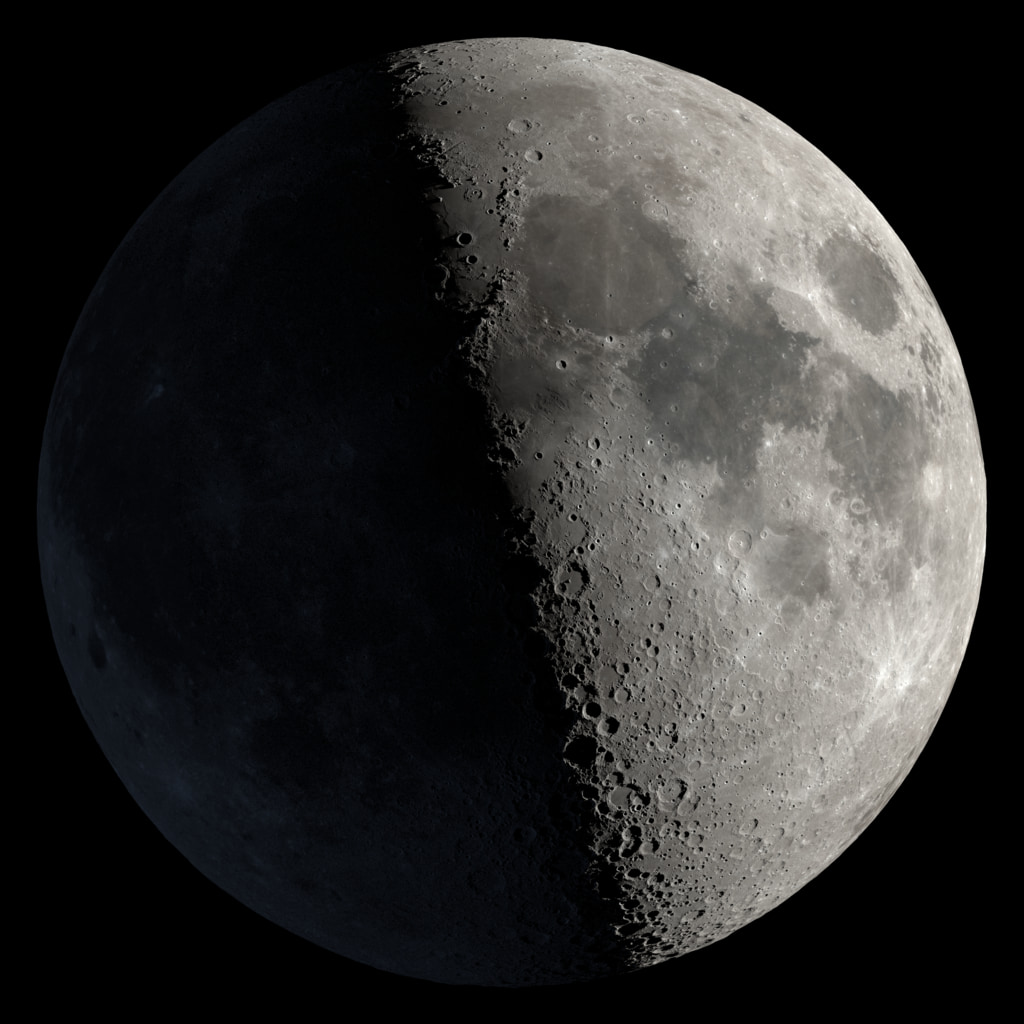
Crater-covered lunar surface imaged by NASA's Lunar Reconnaissance Orbiter. Near full Moon, as on October 24, 2026, craters show little shadow and the bright ray systems dominate

A near-full Moon has almost no shadow at the terminator, so the craters look flat and bright ray systems such as Tycho’s take over. Credit: NASA/GSFC/Arizona State University (LRO).

Saturn on October 24, 2026

  • • Constellation: Cetus, near the Pisces border
  • • Magnitude: +0.4
  • • Disk diameter: 19.6″
  • • Ring tilt: ~7° (south face)
  • • Highest: ~11:45 p.m. local, about 50° up from 39°N

Want to know what to expect before you look? Read what Saturn really looks like through a telescope, how much magnification you need for the rings, and our Saturn ring-tilt calendar.

Bonus: Find Neptune Near the Moon on October 23

Neptune is lingering in Pisces, about 7.5° from Saturn. On Friday evening, October 23, the Moon passes within roughly 4° of Neptune. That puts the most distant planet in the same binocular field as the Moon’s glare, and it makes Neptune easier to locate than at any other time this month.

At magnitude 7.7 Neptune is invisible to the naked eye. It is a faint, slightly bluish “star” in 10×50 or 15×70 binoculars, and a tiny blue-gray disk (2.3″) at 150× or more in a telescope. Use Saturn as your signpost: from Saturn, sweep about 7–8° toward the upper right (toward the Moon on the 23rd). Then check a planetarium app such as Stellarium or SkySafari to tell Neptune apart from the field stars. Moonlight makes this a real challenge, so try again in early November once the Moon has left the evening sky.

Step-by-step help: how to see Neptune with a telescope and can a 4-inch telescope show Neptune?

What This Means for Amateur Astronomers

A Moon-Saturn conjunction at 8–10° is not rare in itself; the Moon passes Saturn every month. What makes this weekend worth your time is the setting: Saturn is still near opposition size, the rings are opening, and it is high in a comfortable evening sky. Here is how to use it:

  1. Use it as a finder for beginners. Anyone who has never knowingly seen Saturn can find it on Friday or Saturday with no app at all: “the bright one beside the Moon.” If you have a new or idle telescope, this is the easiest first-planet night of the autumn.
  2. Plan around the glare. Deep-sky observing is out this weekend. Spend the session on Saturn, then on the Moon’s bright ray systems (Tycho, Copernicus, Kepler) at low power with a filter, and wait for the November dark window for faint objects.
  3. Practice photographing a wide pairing. At 8–10° the pair fits a phone’s main camera on a tripod, or a 50–85mm lens on a camera. Expose for Saturn and let the Moon blow out, or shoot during blue twilight on Friday so the sky and Moon are balanced.
  4. Watch Saturn’s moons shuffle. Sketch Titan’s position on Friday and again on Saturday. It moves visibly from night to night along its 16-day orbit.
  5. Use the season. Saturn stays well placed in the evening sky through December, and the next Moon-Saturn pairing (November 20) lands on the opening weekend of Black Friday telescope deals.

Best Telescopes for Seeing Saturn’s Rings Next to the Moon

You do not need a big or expensive instrument for this pairing. Saturn’s rings are a 40× target, and the Moon needs no aperture at all. These are the scopes we would actually set up on the lawn this weekend, from the cheapest way to see the rings to a GoTo scope that finds Saturn for you:

Sky-Watcher Heritage 130P

Sky-Watcher Heritage 130P

The lowest-cost way to see Saturn's rings and Titan sharply. A 130mm tabletop Dobsonian that is set up in two minutes, ideal for a spur-of-the-moment conjunction night.

Celestron StarSense Explorer DX 130AZ

Celestron StarSense Explorer DX 130AZ

Your phone tells you exactly where to push the tube, so a beginner lands on Saturn, Neptune and the Moon's craters without star-hopping. The best beginner pick for planet nights.

Celestron NexStar 6SE

Celestron NexStar 6SE

A 150mm GoTo Schmidt-Cassegrain that slews to Saturn and tracks it. It reaches the magnification that shows the Cassini Division on steady nights. Our long-run pick for planets.

Accessories That Make a Near-Full-Moon Night Better

With the Moon 94–98% lit, the most useful upgrade this weekend is not a bigger telescope. It is a way to tame the Moon and a way to capture what you see:

SVBONY Variable Polarizing Moon Filter

SVBONY Variable Polarizing Moon Filter

Dial the near-full Moon down from dazzling to comfortable, then open it fully for Saturn. The single most useful accessory for this weekend.

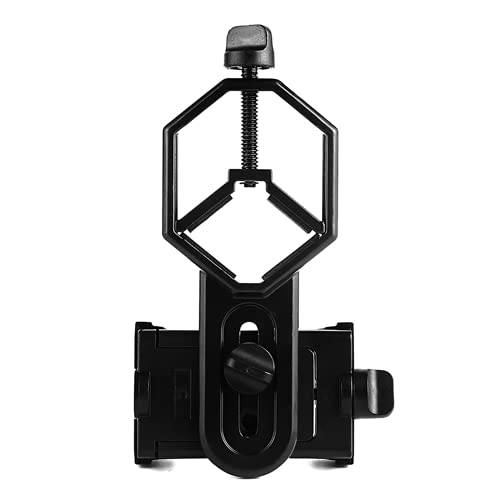
SVBONY Universal Phone Adapter

SVBONY Universal Phone Adapter

Clamps your phone square to the eyepiece for steady Moon photos and short Saturn video clips you can stack later.

Celestron SkyMaster 15x70 Binoculars

Celestron SkyMaster 15x70 Binoculars

Frames the Moon and Saturn together on Friday and reaches magnitude-7.7 Neptune. Best on a tripod.

Celestron Omni 2x Barlow Lens

Celestron Omni 2x Barlow Lens

Doubles every eyepiece you own. The cheapest way to push a beginner scope from 65x to 130x for a bigger view of the rings.

Comparing more options? See the best telescopes for viewing Saturn in 2026, our variable Moon filter guide, and, if you are planning to buy before the November pairing, our Black Friday telescope deals tracker.

Next Moon-Saturn Conjunctions in 2026

Saturn is near the ecliptic, so the Moon passes it once every lunar orbit, about every 27 days. For the rest of 2026 each pairing lands with a slimmer Moon, which means less glare:

Date (US evening)Conjunction (UTC)SeparationMoon lit
Fri Oct 23 / Sat Oct 24Oct 24, 17:406.8°97%
Fri Nov 20Nov 21, 01:206.8°84%
Thu Dec 17 / Fri Dec 18Dec 18, 10:106.9°62%

The November 20 conjunction peaks at about 8:20 p.m. EST, during the evening, which makes it the best-timed of the three for North America. All values are geocentric and computed from the JPL DE421 ephemeris. For every 2026 event, see the astronomy events calendar.

Frequently Asked Questions

What is the bright star next to the Moon tonight?

On October 23 and 24, 2026, the bright, steady, pale-gold point near the Moon is the planet Saturn, at magnitude +0.4. On the 23rd it sits about 8 degrees to the Moon's lower left. On the 24th it sits about 9 to 10 degrees to the Moon's right. Unlike stars, it does not twinkle much, and a small telescope shows its rings.

What time is the Moon-Saturn conjunction on October 24, 2026?

The Moon and Saturn share the same right ascension at about 17:40 UTC on October 24, 2026 (1:40 p.m. EDT, 10:40 a.m. PDT), with the Moon 6.8 degrees north of Saturn. That is daytime in North America, so the best views are on the evenings of October 23 and October 24, when the pair is 8 to 10 degrees apart.

Can I still see the Moon and Saturn together on October 25?

Both are visible on the evening of October 25, but they are about 23 degrees apart, so they no longer look like a pair. Saturn is high in the southeast after dark, and the Moon, essentially full as the Hunter's Moon, is lower in the east.

Will the Moon cover (occult) Saturn this time?

No. The Moon passes about 6.8 degrees north of Saturn, more than 13 times the Moon's own width, so no occultation is visible from anywhere on Earth this month.

Do I need a telescope to see the conjunction?

No. The pairing is easy to see with the naked eye, even from a city. To see Saturn's rings you need a telescope: any 70mm refractor or larger at 40x or more shows them, and a 130mm reflector adds the shadow of the globe on the rings and several of Saturn's moons.

Does the bright Moon make Saturn harder to see?

Not much. Saturn is bright enough to cut through moonlight, and its rings look just as sharp. The glare does hide Saturn's fainter moons and Neptune, so keep the Moon out of your field of view and use a Moon filter when you turn to the Moon itself.

When is the next Moon-Saturn conjunction?

The next one is on the evening of November 20, 2026, when the Moon passes about 6.8 degrees north of Saturn at roughly 8:20 p.m. EST with an 84 percent lit Moon. After that, the Moon meets Saturn again on December 17 to 18, 2026.

Related Guides

Sources, Method & Image Credits

Some links in this article are affiliate links. If you buy through them, we may earn a small commission at no extra cost to you. It never changes which products we recommend. See our affiliate disclosure.