
National Geographic Telescopes: Which Are Worth Buying?
Telescope Advisor Logo Telescope Advisor
Deep-sky nebula background for our guide to National Geographic telescopes

Buying Guide · Beginner Telescopes · 2026

National Geographic Telescopes: Which Are Worth Buying, and Which to Skip

National Geographic telescopes are licensed beginner scopes from the Bresser family, sold in the US by Explore Scientific. A few are sensible first telescopes; one we would avoid. Here is who makes them, every model we found in stock on Amazon US on November 17, 2026, and how each one compares with the alternatives we already recommend.

Licensed toBresser (since 2012)
US sellerExplore Scientific
Models checked9 on Amazon US
Our top pick70mm f/10 refractor
By Telescope Advisor Editorial Team Published: Updated: Reviewed & approved by Juhi Sahni, Senior Editor Editorial Standards

Affiliate disclosure: Telescope Advisor earns a commission from qualifying Amazon purchases made through links on this page, at no extra cost to you. It never affects our recommendations.

How we built this guide: we have not tested a National Geographic telescope ourselves, so this page does not give them review scores. Our picks are based on the published specifications in each Amazon US listing (checked November 17, 2026), the licensing information published by Bresser and Explore Scientific, and our existing reviews of the alternatives. Where a detail could not be confirmed, we say so.

Quick Answer

The best National Geographic telescope for most beginners is the 70mm f/10 refractor (sold as the CF700SM). Its long 700mm focal length suits the Moon and planets, it has slow-motion controls on the mount, and it ships with two Plössl eyepieces and a 2x Barlow. For a child’s gift, the Sky View 70 is simpler to aim and was the only National Geographic model in Amazon’s top 20 Telescopes best sellers when we checked. Skip the 76mm compact tabletop reflector. And know the alternatives: at the same budgets, the Gskyer 70mm, Celestron StarSense Explorer LT 114AZ and Sky-Watcher Heritage 130P are our stronger all-round picks.

Our Pick — Best National Geographic Telescope
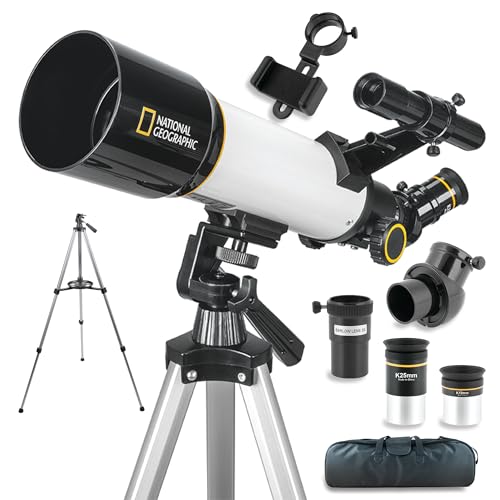
National Geographic 70mm Refractor (CF700SM)

National Geographic 70mm Refractor (CF700SM)

Aperture: 70mm
Focal length: 700mm (f/10)
Mount: Alt-az, slow-motion
Magnification: 26.9x to 144x

A 70mm achromatic refractor with a 700mm focal length (f/10) on an alt-azimuth mount with slow-motion controls. Two Plössl eyepieces and a 2x Barlow give 26.9x, 52x, 72x and 144x. A smartphone adapter is included. Sold on Amazon US by Explore Scientific.

Pros

  • Long focal length suits Moon and planets
  • Slow-motion controls
  • Plössl eyepieces and Barlow

Cons

  • Long tube for a small child
  • 144x is the practical ceiling
  • Narrow field for big star clusters

Who Makes National Geographic Telescopes?

National Geographic licenses its name; it does not design or build telescopes. Here is what the companies involved say publicly:

  • Bresser (Germany) lists 2012 in its company history as the year it signed “a global licensing agreement for optical products and outdoor items” with National Geographic. Bresser UK’s brand page also dates the licensed range to 2012.
  • Explore Scientific (USA) describes itself as an official National Geographic licensee, and as the exclusive distributor of Bresser products throughout the Americas since 2009.
  • On Amazon US, most National Geographic telescope listings we checked on November 17, 2026 show Explore Scientific as the brand, manufacturer or seller. The CF700SM and STARAPP 70mm listings state that they are “manufactured by Bresser and licensed by National Geographic”.

What we could not confirm is which factory builds each model. Neither company names one, so we describe these telescopes as sold under licence by Bresser and Explore Scientific. In practice, they are entry-level telescopes from the same group that sells Bresser and Explore Scientific gear, with National Geographic branding and support from Explore Scientific in the US.

The National Geographic Telescope Lineup on Amazon US

These are the National Geographic telescopes we found with a live Amazon US offer on November 17, 2026. Magnifications are the ones each listing states for the included eyepieces and Barlow. Focal ratio is focal length divided by aperture.

ModelAperture / focal lengthMountListed magnificationsOur take
70mm Refractor (CF700SM)70mm / 700mm, f/10Alt-az with slow-motion controls, adjustable tripod26.9x, 52x, 72x, 144xOur pick. Best all-rounder in the range.
Sky View 7070mm / 400mm, f/5.7Panhandle alt-az, adjustable tripod16x, 40x, 48x, 120xBest gift for kids. Easy to aim.
STARAPP 70mm70mm refractor (focal length not stated)Alt-az, adjustable tripod26.9x, 52x, 72x, 144xSimilar to the CF700SM, plus an astronomy app. Listed under the Bresser brand.
114mm Reflector114mm / 500mm, f/4.4Alt-az, full-size tripod19x, 51.5xGood aperture; add a higher-power eyepiece for planets.
NT114CF 114mm114mm / 500mm, f/4.4Alt-az pan handle, full-size tripodUp to about 100x with the 2x BarlowSame optics class with Plössl eyepieces and a Barlow. Low stock.
114EQ114mm reflectorManual equatorial9.7mm and 26mm PlösslsEQ mounts take learning. Low stock.
50mm Refractor50mm / 360mm, f/7.2Panhandle, adjustable tripod18x, 28.8xMoon and daytime use for young children.
70mm Computerized70mm / 350mm, f/5Computerized tabletop, hand controller18x to 88xLow power ceiling for a GoTo scope. We would choose a manual 70mm instead.
76mm Compact Reflector76mm / 350mm, f/4.6Tabletop18x to 117xSkip. See telescopes to avoid.

Source: Amazon US listings, checked November 17, 2026. Stock and listings change; the 114EQ and NT114CF showed only one unit left. The 90/900 EQ3 refractor (listed on Amazon as “National Geographic Refractor Telescope 90/900 EQ3”) had no buyable offer on that date.

Our Picks, Model by Model

Each pick below is based on specifications, not on our own testing. We compare every model against telescopes we have already reviewed at a similar budget.

1. 70mm Refractor (CF700SM): best National Geographic telescope overall

This is the most “proper” small telescope in the range. A 70mm lens with a 700mm focal length (f/10) gives a naturally higher magnification with each eyepiece, which suits the Moon, Jupiter’s moons and Saturn. Slower refractors like this generally show less purple fringing around bright objects than short f/5–f/6 designs. The alt-azimuth mount has slow-motion controls, which make it easier to keep a planet in view at 72x or 144x. The trade-off is a longer tube and a narrower field of view, so large star clusters like the Pleiades will not fit as comfortably as in the Sky View 70. The card above links to it on Amazon.

2. Sky View 70: best National Geographic telescope as a gift for kids

Best National Geographic Gift for Kids
National Geographic Sky View 70mm Refractor

National Geographic Sky View 70mm Refractor

Aperture: 70mm
Focal length: 400mm (f/5.7)
Mount: Panhandle alt-az
Magnification: 16x to 120x

A 70mm, 400mm focal length refractor on a panhandle mount. Two eyepieces plus a 3x Barlow give 16x, 40x, 48x and 120x. A diagonal, viewfinder, smartphone adapter and accessory tray are included. It was #12 in Amazon’s Telescopes best sellers when we checked on November 17, 2026.

Pros

  • Simple panhandle aiming
  • Wider field than the f/10 model
  • Phone adapter included

Cons

  • Short focal ratio shows more colour on bright objects
  • Small owner base on Amazon so far
  • Same spec as cheaper-to-find rivals

On paper the Sky View 70 matches the Gskyer 70mm AZ refractor almost exactly: 70mm aperture, 400mm focal length, two eyepieces, a 3x Barlow and the same 16x to 120x range. The Gskyer adds a carry bag and a wireless phone remote and has a far larger owner base on Amazon, which is why it remains our recommended pick at this level. If the Sky View 70 is cheaper on the day, or the recipient loves the National Geographic brand, it is a fair alternative.

3. 114mm Reflector: the most aperture in the range

Most Aperture in the Range
National Geographic 114mm Reflector

National Geographic 114mm Reflector

Aperture: 114mm
Focal length: 500mm (f/4.4)
Mount: Alt-az, full tripod
Magnification: 19x and 51.5x

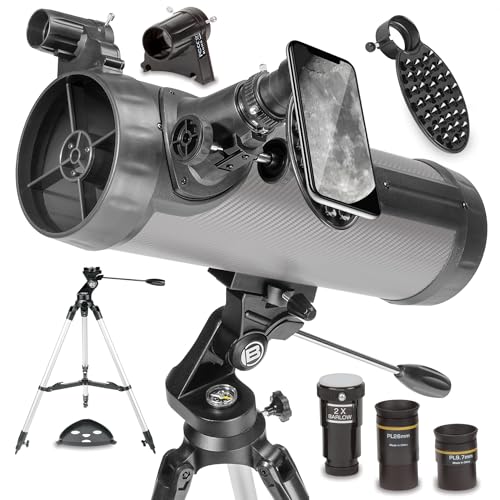
A 114mm Newtonian reflector with a 500mm focal length on an alt-azimuth mount and full-size tripod, with a red-dot finder and smartphone adapter. The two included eyepieces give 19x and 51.5x.

Pros

  • Gathers about 2.7x the light of a 70mm
  • Good for star clusters and brighter nebulae
  • Full-size tripod

Cons

  • 51.5x top power is low for planets
  • Reflectors need occasional collimation
  • Mirror type not stated in the listing

A 114mm mirror collects about 2.7 times as much light as a 70mm lens, which is what you want for star clusters and the Orion Nebula. The weak spot is the eyepiece set: 51.5x is the highest power in the box, so for Saturn and Jupiter you will want to add a 6mm to 10mm eyepiece. The NT114CF version solves that with Plössl eyepieces and a 2x Barlow (up to about 100x), but showed only one unit left on November 17. Before you buy either, compare the Celestron StarSense Explorer LT 114AZ, which has the same aperture class plus a phone-based guidance system that tells you where to point.

4. 50mm Refractor: for young children and daytime viewing

National Geographic 50mm Refractor

National Geographic 50mm Refractor

Aperture: 50mm
Focal length: 360mm (f/7.2)
Mount: Panhandle
Magnification: 18x and 28.8x

A 50mm refractor with a 360mm focal length, a star diagonal, a panhandle mount and a height-adjustable tripod. The two eyepieces give 18x and 28.8x. Best for the Moon, the Pleiades and daytime scenery.

Pros

  • Very simple to use
  • Honest magnification claims
  • Light enough for a child

Cons

  • Too little power for Saturn’s rings
  • Small aperture
  • Outgrown quickly

Credit where it is due: this listing makes no wild magnification claims, and it says plainly that the scope is for the Moon and nature viewing. That is what it will do well. If the child is 8 or older, a 70mm model is a better long-term gift; see our best telescope for an 8-year-old guide.

Which National Geographic Telescopes to Skip

  • 76mm Compact Reflector (76/350 tabletop). A very short f/4.6 reflector on a small tabletop mount, sold with 6mm and 20mm eyepieces, a 2x Barlow and a stated range of 18x to 117x. We include it in our telescopes to avoid guide. For a tabletop scope, the Sky-Watcher Heritage 130P is in a different league.
  • 70mm Computerized tabletop (70/350). Automatic alignment is appealing, but the listing’s own figures top out at 88x, and the scope sits on a tabletop tripod. A manual 70mm refractor with a better eyepiece set will show more, and our GoTo for beginners guide explains when computerized mounts are worth it.

Better-Value Alternatives at the Same Budgets

If the National Geographic name is not the point of the gift, these are the telescopes we already recommend at similar budgets. All were in stock on Amazon US on November 17, 2026.

Instead of the Sky View 70
Gskyer 70mm AZ Refractor

Gskyer 70mm AZ Refractor

Same 70mm / 400mm spec, plus a carry bag and phone remote. Amazon’s #1 telescope best seller on November 17, 2026.

Instead of the 70mm models
Celestron AstroMaster 70AZ

Celestron AstroMaster 70AZ

A long-running 70mm refractor on a sturdier tripod, from a brand with wide US support.

Celestron Travel Scope 70

Celestron Travel Scope 70

A 70mm travel kit with a backpack: easy to take camping or to grandparents’ houses.

Instead of the 114mm models
Celestron StarSense Explorer LT 114AZ

Celestron StarSense Explorer LT 114AZ

A 114mm reflector whose phone app shows you where to point. Our favourite first telescope at this level.

Instead of the 76mm compact
Sky-Watcher Heritage 130P

Sky-Watcher Heritage 130P

A 130mm collapsible tabletop Dobsonian: the tabletop telescope to buy.

For more choices by budget, see our best telescopes under $100, best telescopes under $200 and best telescopes for beginners guides, or the full Amazon best-seller list, rated.

Buying a National Geographic Telescope as a Gift

  • Check the seller line. On Amazon US most of these telescopes are sold by Explore Scientific, and one (the NT114CF) by Amazon.com. Both are fine; avoid third-party resellers you do not recognise.
  • Plan the first night. The Moon is the best first target for every model on this page. Our telescope setup guide covers aligning the finder in daylight, which avoids most first-night frustration.
  • Ignore the biggest number on the box. No 70mm telescope shows sharp detail much above 140x. Our magnification explainer shows why.
  • Never point any of these at the Sun without a certified solar filter over the front of the telescope.

More help in how to buy a telescope as a gift and our Christmas telescope gift guide.

National Geographic Telescopes: Frequently Asked Questions

Who makes National Geographic telescopes?
National Geographic does not make telescopes itself. The German optics company Bresser signed a global licence for National Geographic optical and outdoor products in 2012. In the US the telescopes are sold by Explore Scientific, which is an official National Geographic licensee and Bresser's exclusive distributor in the Americas. On Amazon US most listings show Explore Scientific as the brand or seller, and several say they are manufactured by Bresser and licensed by National Geographic.
Are National Geographic telescopes any good?
Some are. The 70mm f/10 refractor (sold as the CF700SM) and the Sky View 70 are reasonable first telescopes on paper, with real glass optics, a diagonal and useful eyepieces. The 114mm reflectors give more aperture but ship with modest magnification. We would skip the 76mm compact tabletop reflector. At most budgets there is an equally good or better alternative from Celestron, Sky-Watcher or Gskyer.
Which National Geographic telescope is best for kids?
For children around 8 and up, the Sky View 70 is the easiest pick: a 70mm refractor on a simple panhandle mount with a smartphone adapter. The 50mm refractor suits younger children who mainly want to look at the Moon and daytime scenery, but its two eyepieces only reach about 29x.
Is the National Geographic Sky View 70 the same as the Gskyer 70mm?
They are not the same product, but they share the same headline specification: a 70mm refractor with a 400mm focal length, two eyepieces, a 3x Barlow lens and a smartphone adapter, giving 16x to 120x. The Gskyer adds a carry bag and a wireless phone shutter remote and has a much larger owner base on Amazon. Pick on availability and price on the day.
Can you see Saturn's rings with a National Geographic telescope?
Yes, with the 70mm and 114mm models, using the higher-power eyepiece or Barlow on a steady night when Saturn is above the horizon. The rings will look small. The 50mm model's 29x top magnification is too low to show them clearly.
Is the National Geographic 76mm compact telescope worth it?
We do not recommend it. It is a short 350mm focal length tabletop reflector, and we list it in our telescopes to avoid guide. A Sky-Watcher Heritage 130P tabletop Dobsonian or a Celestron AstroMaster 70AZ is a far better use of the money.
Are National Geographic telescopes the same as Bresser telescopes?
They come from the same licensing arrangement. Amazon US listings for the 70mm CF700SM and the STARAPP 70mm say they are manufactured by Bresser and licensed by National Geographic, and the STARAPP listing shows Bresser as the brand. Treat them as Bresser-family entry-level telescopes with National Geographic branding.
Where do I get support for a National Geographic telescope in the US?
Most Amazon US listings are sold by Explore Scientific, and the listings say customer service is based in Springdale, Arkansas. Keep the Amazon order details: Amazon's own return policy applies to purchases made there.

Sources

  • Bresser, company history (bresser.com), 2012 National Geographic licensing entry, checked November 17, 2026
  • Bresser UK, brand page (bresseruk.com), checked November 17, 2026
  • Explore Scientific, About Us (explorescientific.com), checked November 17, 2026
  • Amazon US listings for each National Geographic telescope named on this page, checked November 17, 2026
  • Amazon US Best Sellers in Telescopes, snapshot taken November 17, 2026