First Green Star Found: The White Dwarf Tinted by Sodium
Telescope Advisor Logo Telescope Advisor
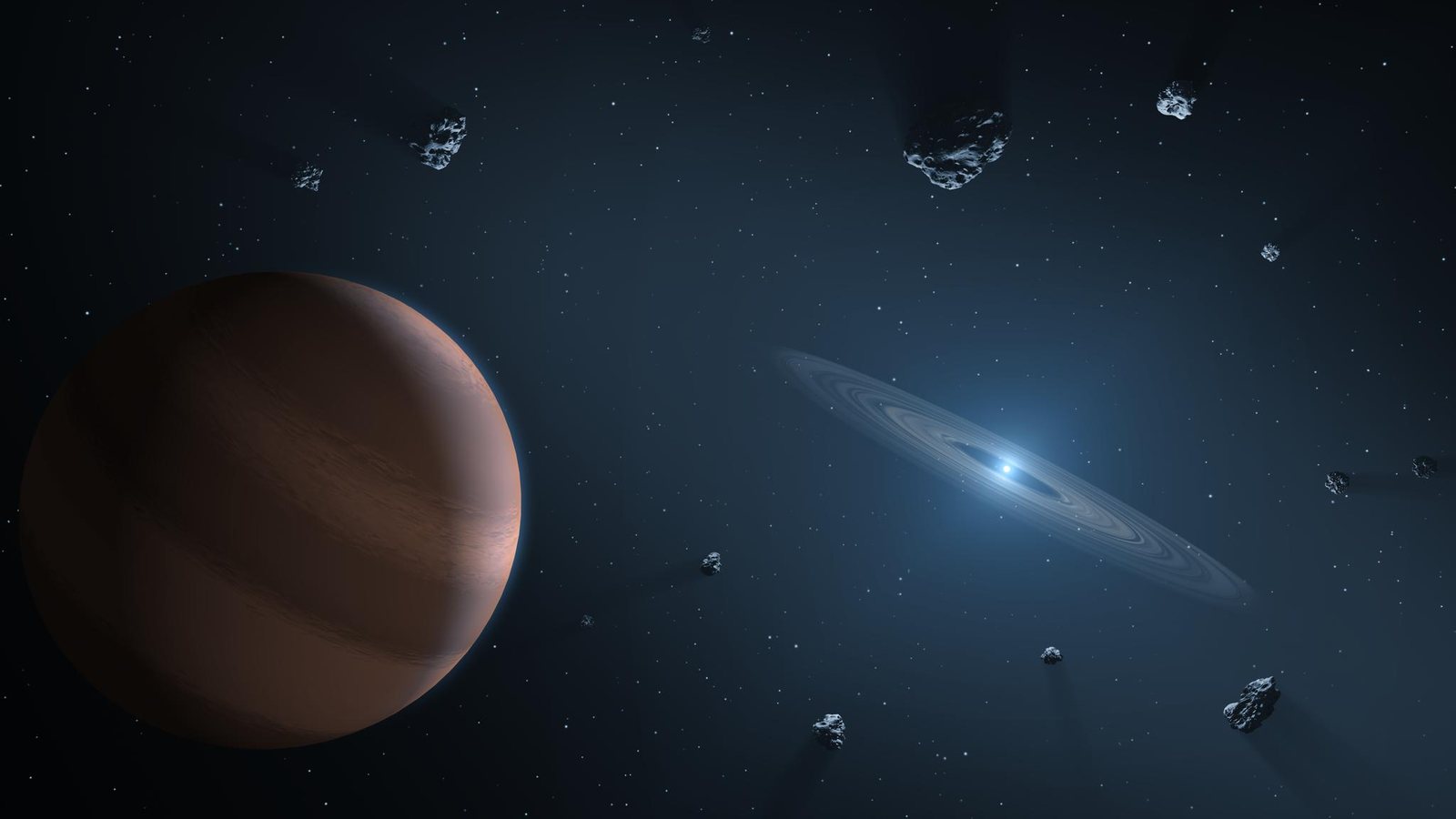
Artist's concept of a polluted white dwarf: a small, intensely bright stellar remnant surrounded by a glowing disc of rocky debris, with a planet in the foreground

Star Science · White Dwarfs · October 2026

First Green Star Found: A White Dwarf Tinted by Sodium

Look up on any clear night and you'll find red, orange, yellow, white and blue stars, but never a green one. Astronomers at the University of Warwick have now identified the first star that would genuinely look green to a human eye. It's a burnt-out stellar core, and its colour comes from the wreckage of its own planets.

StarWD J1330+6435
Distance~280 light-years
ConstellationDraco
AnnouncedOctober 15, 2026
By Telescope Advisor Editorial Team Published: Updated: Reviewed & approved by Juhi Sahni, Senior Editor Editorial Standards
Elena Reyes — Senior Science Editor

Elena Reyes

Senior Science Editor

Covers NASA missions, space science discoveries, and astronomical events for Telescope Advisor. Translates complex astrophysical research into practical insights for backyard observers. Based in the San Francisco Bay Area.

Content reviewed by our editorial team. Research and drafting assisted by AI to ensure unbiased, data-driven analysis. Learn more about our editorial process.

The Short Version

  • What: a white dwarf called WD J1330+6435, about 280 light-years away in Draco, is the first star known that would look green to human eyes.
  • Why green: its atmosphere is laced with sodium (plus calcium and lithium) from rocky debris it swallowed. In that ultra-dense gas, sodium soaks up a broad band of yellow, orange and red light, leaving a chartreuse glow.
  • Who: a team led by Dr Mark Hollands of the University of Warwick, published in RAS Techniques and Instruments and announced on October 15, 2026.
  • The bigger finding: in a sample of 151 nearby white dwarfs, most look plain white, but roughly 1 in 30 has an unusual tint: yellow, pink, purple or cyan.
  • Can you see it? No. It's far too faint for any backyard telescope. But you can see real star colours tonight, and we show you where below.

How the Green Star Was Found

White dwarfs are what's left when a star like the Sun runs out of fuel: a hot, exposed core roughly the size of Earth, slowly cooling for billions of years. Almost all of them are, as the name promises, white. The Warwick team set out to test that assumption properly. They took the measured spectra of white dwarfs, the full breakdown of their light by wavelength, and worked out what colour each one would appear to a person with normal vision standing close enough to see it.

One object stood out. WD J1330+6435 came out a pale, yellowish green, a shade the team describes as chartreuse. No star had ever been shown to have a genuinely green colour before. Picture a planet with that in its sky: "It feels like something out of science fiction," Hollands said in the university's announcement.

The study, a survey of white dwarf "chromaticities" (the precise colours of their light), is by Mark Hollands, Boris Gänsicke, Pier-Emmanuel Tremblay and Detlev Koester, and appears in the Royal Astronomical Society journal RAS Techniques and Instruments. One honest caveat: nobody has looked at this star and seen green. The colour is computed from the starlight we measure, combined with a model of how human eyes respond to colour. That's the only way to do it, since the star is far too faint for anyone's eye to register its colour through a telescope.

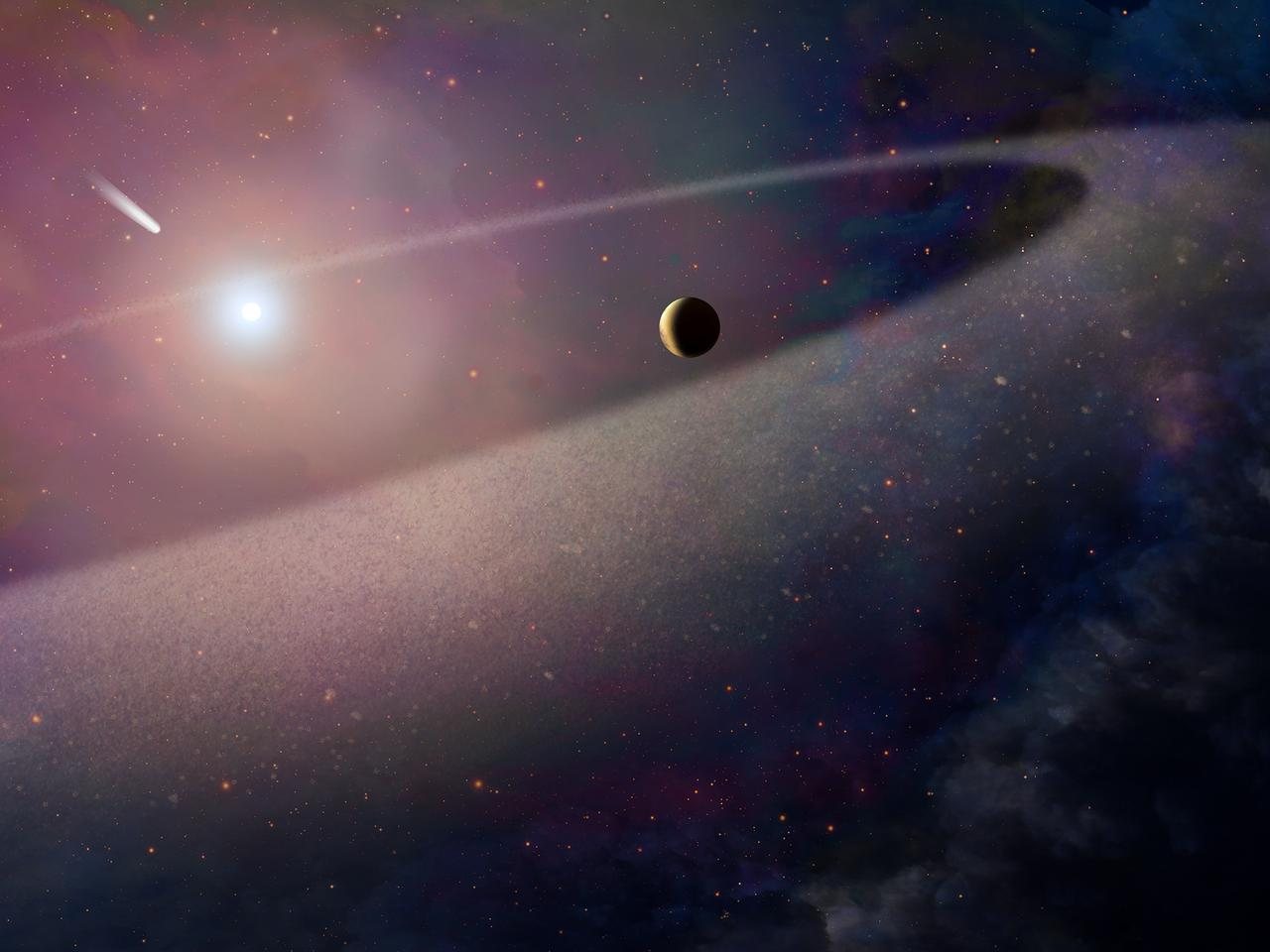
Artist's concept of a comet-like body being torn apart and falling onto a white dwarf, scattering debris that pollutes the star's atmosphere with heavy elements
How white dwarfs get "polluted": rocky or icy bodies that stray too close are shredded by the white dwarf's gravity and rain down onto its surface. That's how sodium, calcium and lithium ended up in the atmosphere of WD J1330+6435. This illustration shows a different white dwarf studied by Hubble in 2017. Credit: NASA, ESA, and Z. Levay (STScI). Public domain.

WD J1330+6435 by the Numbers

~280 ly

Distance from Earth, from the star's Gaia parallax of 11.58 milliarcseconds (about 86 parsecs).

Draco

Its constellation. The coordinates in its name (13h 30m, +64° 35′) put it in the dragon's coils, between the Big Dipper and the Little Dipper.

~4,000°C

Surface temperature reported by Warwick, cool for a white dwarf. That coolness is part of why its atmosphere is so dense.

Na, Ca, Li

Sodium, calcium and lithium detected in its atmosphere, delivered by rocky material from its former planetary system.

151

White dwarfs in the team's reference sample, every one within 20 parsecs (about 65 light-years) of the Sun.

~1 in 30

Share of white dwarfs the team estimates have an unusual colour. In the nearby sample, 5 of 151 did: 2 yellow and 3 pink.

Sources: University of Warwick release (Oct 15, 2026); Hollands et al., RASTI, DOI 10.1093/rasti/rzag069. Distance and constellation: our calculation from the star's Gaia EDR3 parallax and position, as listed in the Montreal White Dwarf Database.

Why Sodium Turns This Star Green

If you've seen an old orange streetlight, you've seen sodium at work: heated sodium glows at one very specific orange-yellow wavelength. Sodium atoms also do the reverse, absorbing light at that same wavelength. In the thin gas of a normal star's atmosphere that just carves a narrow dark line in the spectrum, far too small to change the colour you see.

A cool white dwarf is different. Its gravity is so intense that its outer atmosphere is crushed to a density of up to about 1 gram per cubic centimetre, close to the density of water. Packed that tightly, the sodium atoms are constantly jostled by helium atoms, which smears their absorption out across a wide swath of the spectrum. Instead of a thin line, sodium removes a broad chunk of yellow, orange and red light. Take those colours away from roughly white light and what's left looks green.

So where did the sodium come from? White dwarfs should have very clean atmospheres, because heavy elements sink out of sight quickly under that gravity. Finding sodium, calcium and lithium at the surface means fresh material is being added. The accepted explanation is that the white dwarf is eating the remains of its planetary system: asteroids or fragments of rocky planets that wander too close, get torn apart, and fall in. Our own Sun will become a white dwarf in about five billion years, and whatever is left of its asteroid belt could one day tint it too.

Artist's concept of an exoplanet and a bright debris disk orbiting a polluted white dwarf; material from the disk falls onto the star and adds heavy elements to its atmosphere
A polluted white dwarf (artist's concept). A planet's gravity can nudge small rocky bodies inward, where the white dwarf breaks them into dust that falls onto its surface. Credit: NASA/JPL-Caltech (PIA22084). Public domain.

Pink, Purple, Cyan: The Hidden Palette of White Dwarfs

The green star grabbed the headlines, but the study's broader point is that white dwarfs come in more shades than anyone had pinned down. Most behave like what physicists call near-perfect radiators, glowing with a smooth spread of colours that the eye sees as white; the typical star in the nearby sample has a colour temperature of about 6,800 K. A minority have atmospheres that bend that rule.

Pink and purple: carbon dredged up from the core

In some white dwarfs, carbon from the interior reaches the surface and forms molecules that absorb much of the bluer light. The reddest object in the study, WD J1011+2845, about 48 light-years away in Leo Minor, sends most of its light out beyond 600 nanometres and comes out a salmon pink.

Yellow: debris-laden atmospheres

White dwarfs that have swallowed planetary material tend toward yellow. WD J1330+6435 is the extreme case, where the sodium absorption is strong enough to push the colour all the way to green.

Cyan and pale blue: cool hydrogen-helium mixes

Cooler white dwarfs whose atmospheres blend hydrogen with helium can come out cyan or pale blue. The most famous white dwarf of all, Sirius B, the faint companion of the night sky's brightest star, rates a pale blue in the team's scheme.

Professor Boris Gänsicke summed up the result with a reassurance: one in thirty adds up to "a lot of oddly coloured stars out there," but "the average white dwarf really is white." Hollands added that some of the colours "genuinely surprised me." Large spectroscopic surveys now under way will measure far more white dwarfs, so WD J1330+6435 may not stay the only green star for long.

Why Ordinary Stars Are Never Green

It seems like there should be green stars. A star's colour follows its temperature: cool stars put out most of their light in the red, hot stars in the blue, and somewhere in between a star's output must peak in the green. The Sun's output, in fact, peaks around green-yellow wavelengths. So why does nobody call the Sun green?

Because a normal star doesn't emit only at its peak. It shines across the entire visible spectrum, with almost as much red and blue light as green. When your eye receives that broad mix, it adds the colours together and you perceive white. To look green, a star would have to give off green light and very little else, and thermal glow simply can't do that. You can only get green by removing the other colours, which is exactly what the sodium in WD J1330+6435 does.

That's also why the colours you see in the night sky run in one direction: red, orange, yellow, white, blue-white. Through a telescope, the differences are subtle pastel tints rather than the saturated colours of astrophotos, much like the faint tones of nebulae we covered in can you see colour in nebulae through a telescope?

What This Means for Amateur Astronomers: Real Star Colours to See This Season

First, the bad news. WD J1330+6435 is a tiny, cool, distant stellar ember, catalogued by deep surveys such as Gaia and the Sloan Digital Sky Survey. It's far too faint to show up in a backyard telescope, let alone show its colour. The same goes for every other white dwarf in the study except Sirius B, and Sirius B is notoriously hard to separate from the glare of Sirius.

The good news is that the sky is full of coloured stars you can see, and late autumn is a great time to hunt them. Times below are for mid-northern latitudes (around 40°N) in early November.

TargetColoursWhere & whenEquipment
Albireo (β Cygni)Gold-orange giant (mag 3.1) with a blue companion (mag 5.1), about 35″ apartHigh in the west after dusk, sinking by late evening. Cygnus guideAny telescope at 20–30×
Almach (γ Andromedae)Yellow-orange primary (mag 2.3), deep blue companion (mag 4.8), about 9.6″ apartHigh in the east during the evening. Andromeda guideSmall telescope at 50× or more
Garnet Star (μ Cephei)One of the reddest naked-eye stars; William Herschel called it garnet in 1783. Varies from about mag 3.4 to 5.1High in the north all evening, in CepheusBinoculars or a small telescope
Betelgeuse & RigelOrange-red supergiant vs blue-white supergiant, the classic colour contrastRising in the east by mid-evening, well up by midnight; better each week into winter. Orion guideNaked eye or binoculars

The "Green Star" You Might Think You See

Observers have long reported green companions in double stars. The famous example is Antares B, the faint partner of red Antares in Scorpius, which many people describe as green. It's actually a hot blue-white star. The green impression is a contrast effect: next to a vivid orange or red primary, your eye tends to tint the fainter companion with the opposite colour. Antares is a summer object, so save it for next June and July; the pair is only about 3″ apart and needs around 100× and steady air. See our Scorpius guide.

Tips for Seeing Star Colour

  • Colour shows best in bright stars, because your eye's colour-sensing cells need plenty of light.
  • Try a slight defocus: spreading the star into a small disc can make its tint easier to judge.
  • Compare stars side by side. A pair like Albireo makes subtle tints obvious.
  • Let your eyes adapt to the dark, and avoid looking at bright screens between views.

Any small scope will show these colours; our best telescopes for beginners and best refractor telescopes guides are good starting points.

Want to see a white dwarf's handiwork?

The Ring Nebula (M57) in Lyra is the glowing shell of gas thrown off by a star as it became a white dwarf. It's an easy small-telescope target in the western sky on autumn evenings, and a preview of how stars like the Sun end their lives.

Frequently Asked Questions

What is the first green star?

The first star shown to have a genuinely green colour is WD J1330+6435, a white dwarf about 280 light-years away in the constellation Draco. A University of Warwick team led by Mark Hollands announced it on October 15, 2026, in a study published in RAS Techniques and Instruments.

Why is WD J1330+6435 green?

Its atmosphere contains sodium, along with calcium and lithium, from rocky debris of its former planetary system. Because the atmosphere is extremely dense, the sodium absorbs a broad range of yellow, orange and red light instead of a single narrow line. With those colours removed, the remaining light looks green.

Are there green stars in the night sky?

No naked-eye star is truly green. Ordinary stars emit light across the whole visible spectrum, so even a star whose output peaks in the green looks white. Some double-star companions, such as Antares B, can appear greenish, but that is a contrast effect next to a red or orange primary.

Can I see the green star with a telescope?

No. WD J1330+6435 is a small, cool white dwarf detected by deep surveys such as Gaia and the Sloan Digital Sky Survey, and it is far too faint for a backyard telescope. Its green colour was calculated from its measured spectrum and a model of human colour vision.

What colours can white dwarfs be?

Most white dwarfs look white. About 1 in 30 has an unusual tint: carbon-rich ones look pink or purple, debris-polluted ones lean yellow (and in one case green), and some cooler stars whose atmospheres blend hydrogen and helium look cyan or pale blue. Sirius B rates as pale blue.

What is the pink white dwarf in the study?

WD J1011+2845, about 48 light-years away, is the reddest star in the study. Carbon brought up from its core forms molecules that push most of its light beyond 600 nanometres, giving it a salmon-pink colour.

Which coloured stars can I see with a small telescope?

Good autumn targets are Albireo in Cygnus (gold and blue), Almach in Andromeda (yellow-orange and deep blue) and the Garnet Star, Mu Cephei (deep red). Later in the evening, compare orange-red Betelgeuse with blue-white Rigel in Orion.

Sources


Continue Exploring

Keep the session going with the next useful answer

Choose the next page based on whether you need a recommendation, a comparison, or a practical observing plan.

Use Finder Tool →

🎄 Holiday season: Telescope Christmas Gift Guide 2026 · Black Friday deal tracking

More Star Science & Observing Guides