Webb Maps Supernova Dust in Cassiopeia A and Finds a Star That Mixed Its Layers Before It Died
About 11,000 light-years away, the wreckage of an exploded star still carries a chemical record of how that star was built. By sorting the dust in the Cassiopeia A supernova remnant into silica, carbon and magnesium silicate, a team using the James Webb Space Telescope has found new evidence that the star’s carbon- and oxygen-burning layers merged shortly before it blew apart. The study was published on November 23, 2026. Here is what Webb saw, why the dust matters, and how to find Cas A in tonight’s sky.
Distance~11,090 ly (NASA)
Explosion seenLate 1600s
InstrumentWebb MIRI spectrometer
Dust typesSilica, carbon, Mg silicate
ConstellationCassiopeia
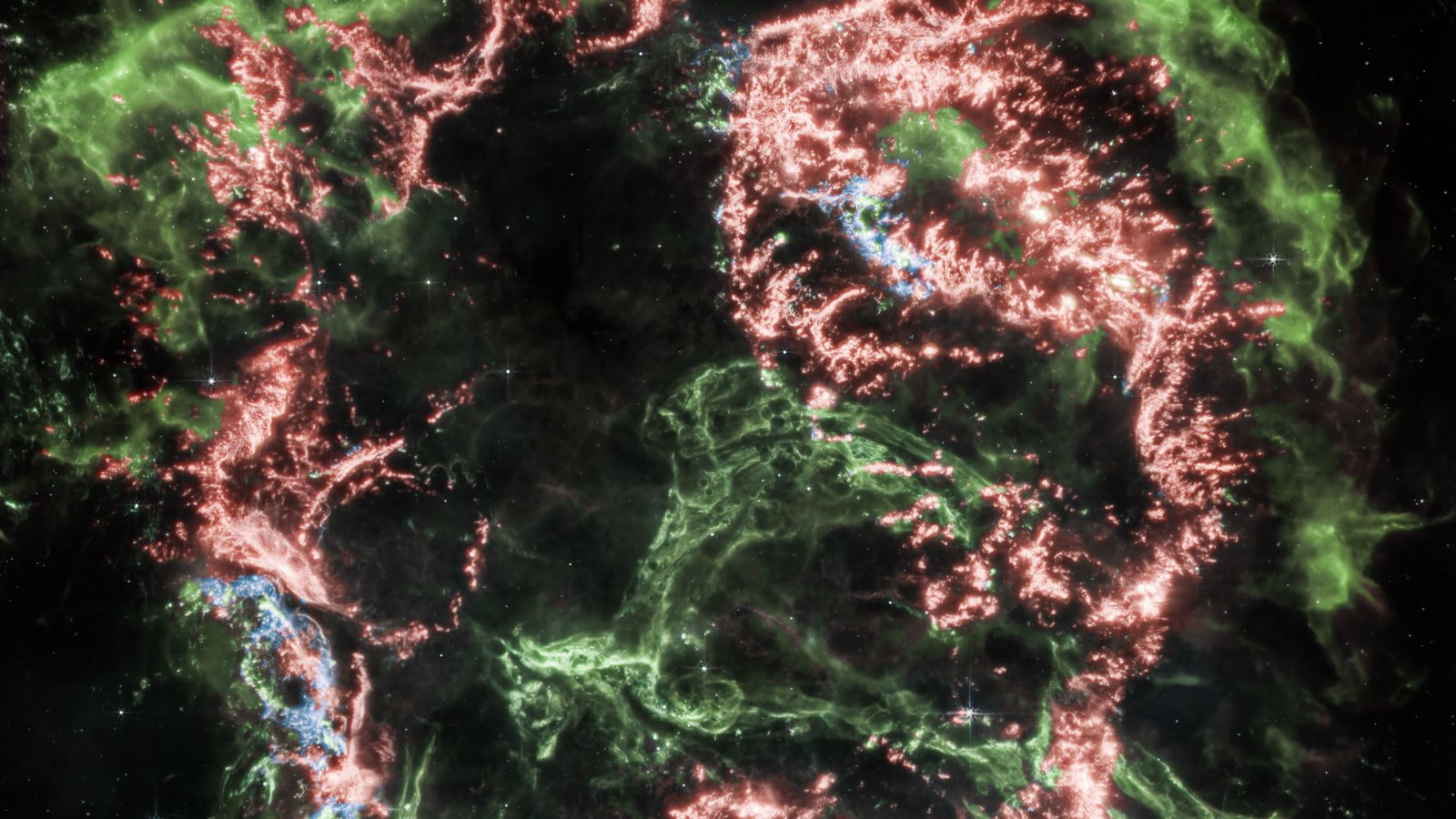
Cassiopeia A in mid-infrared light from Webb (cropped). Credit: NASA, ESA, CSA, STScI, Tea Temim (Columbia University), Rick Arendt (UMBC), Dan Milisavljevic (Purdue University); image processing: Joseph DePasquale (STScI).
By Telescope Advisor Editorial Team|Published: |Updated: |Reviewed & approved by Juhi Sahni, Senior Editor|Editorial Standards
Juhi Sahni
Senior Editor, Space News
Telescope Advisor
Senior Editor at Telescope Advisor, overseeing space news coverage and holding editorial responsibility for everything published on the site. Coverage includes NASA and ESA mission updates, JWST and Roman Space Telescope findings, sky-event guides, and equipment analysis that ties space science back to practical observing. Every factual claim is verified against primary sources — NASA/JPL Horizons, the International Meteor Organization, the US Naval Observatory, and mission briefings — before publication. LinkedIn →
The Short Version
The target:Cassiopeia A (Cas A), the expanding debris cloud of a massive star whose explosion would have been visible from Earth in the late 1600s. It is one of the most studied supernova remnants in the sky.
What Webb did: its MIRI Medium-Resolution Spectrometer recorded the infrared glow of dust in individual clumps of debris, each only about the size of a solar system, and identified the main mineral in each one.
What it found:silica dominates the argon-rich debris, amorphous carbon dominates the neon-rich debris, and the “Green Monster” filament is made of warm magnesium silicate, matching gas the star threw off before it died.
Why it matters: when the team fed those dust recipes into supernova models, the best match came from a star whose carbon-burning and oxygen-burning shells had merged shortly before the explosion. That agrees with earlier X-ray evidence from Chandra and XRISM.
The paper: Temim et al., The Astrophysical Journal Letters 1012, L26, published November 23, 2026.
For observers: Cas A is a tough camera target, but it lies just 2.8° south of the star cluster M52, high in the northwest on late-November evenings. Details below.
What Webb Found in the Dust of Cassiopeia A
When a heavy star dies as a supernova, it scatters the elements it built over millions of years into space. As that debris cools, some of the atoms stick together into microscopic grains of dust. The grains formed in one part of the debris depend on which elements are available there, so a map of dust types is also a map of where each element ended up.
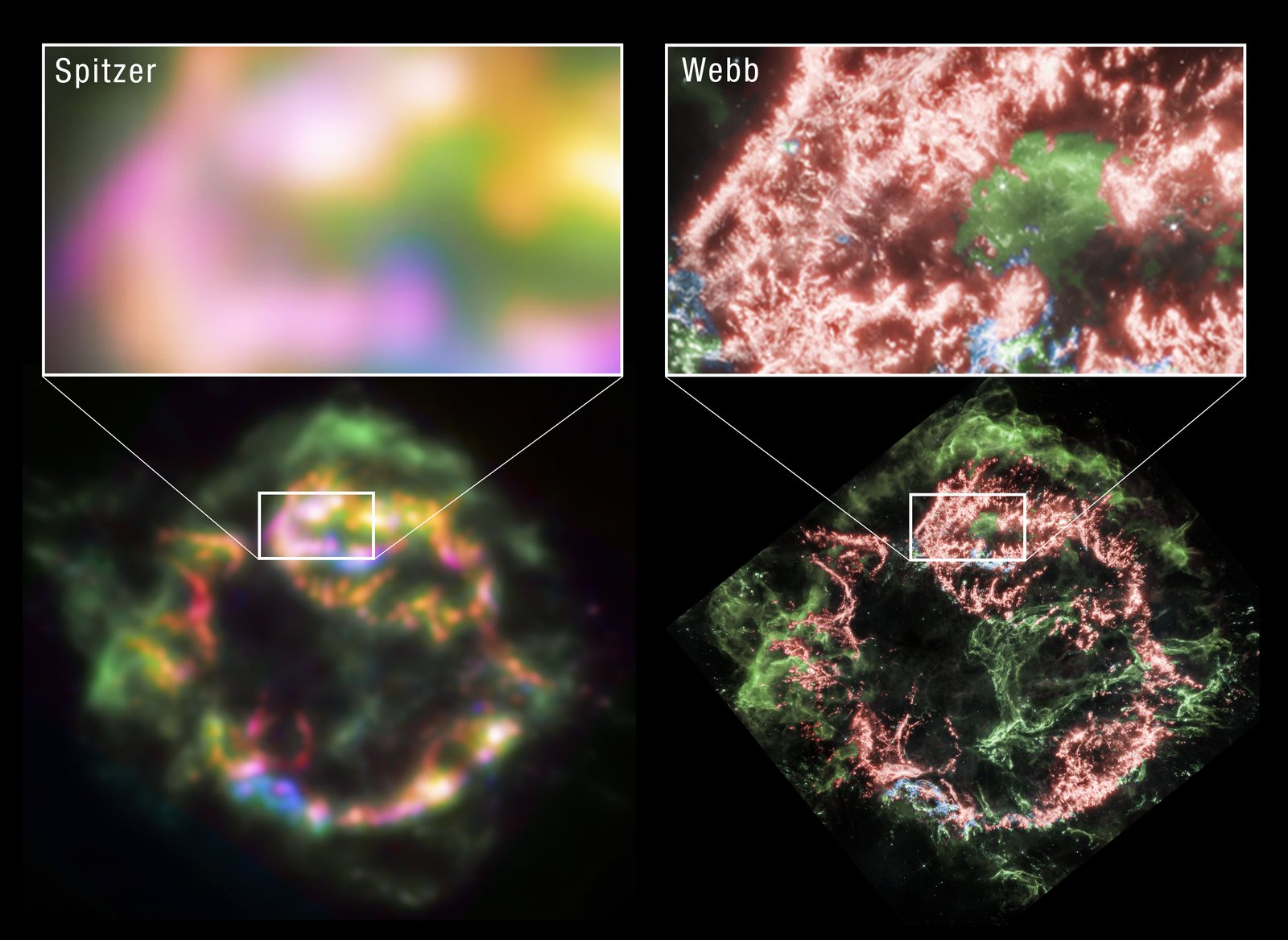
Webb’s infrared spectrometer is sharp enough to isolate clumps of Cas A’s debris just an arcsecond or so across, then split each clump’s light into a spectrum showing which minerals are glowing. The team, led by Tea Temim of Columbia University, chose three test regions, using older images from NASA’s now-retired Spitzer Space Telescope to decide where to point:
Region
What it is
Dominant dust
Argon-bright debris
Supernova ejecta recently hit by the reverse shock, a shock wave that travels back into the debris
Silica (SiO2), traced by a dust feature at 21 microns
Neon-bright debris
Ejecta rich in neon and carbon monoxide, also in the reverse-shocked zone
Amorphous carbon
The Green Monster
Gas and dust the star lost before it exploded (circumstellar material)
Warm magnesium silicate (Mg2SiO4)
Source: Temim et al. 2026 (ApJL 1012, L26) abstract and NASA’s November 23, 2026 release.
The team then looked for those same spectral signatures across the whole remnant. The silica feature turned up through much of the shocked debris, while carbon dust was confined to two crescent-shaped, neon-rich zones. NASA notes that the merger fingerprints show up over most of the remnant, not just in one corner.
Those mineral proportions give the researchers an extra handle on elements such as silicon and magnesium that lock themselves into solid grains and are therefore under-counted by measurements of glowing gas alone. Combining both, the team compared the totals with one-dimensional computer models of how supernovae forge elements. The models that fit best describe a star that went through a carbon–oxygen shell merger. In the paper’s words, the result adds to growing evidence for that scenario in Cas A.
Temim told NASA that material inside the burning shells “churns and circulates,” and that if two shells fuse, the star’s structure changes enough to alter the mix of elements left behind. Co-author Dan Milisavljevic of Purdue University, who leads the Webb observing program, credited the ability to work “at the individual clump level” for the more detailed dust chemistry.
How to Read the New Webb Image of Cassiopeia A
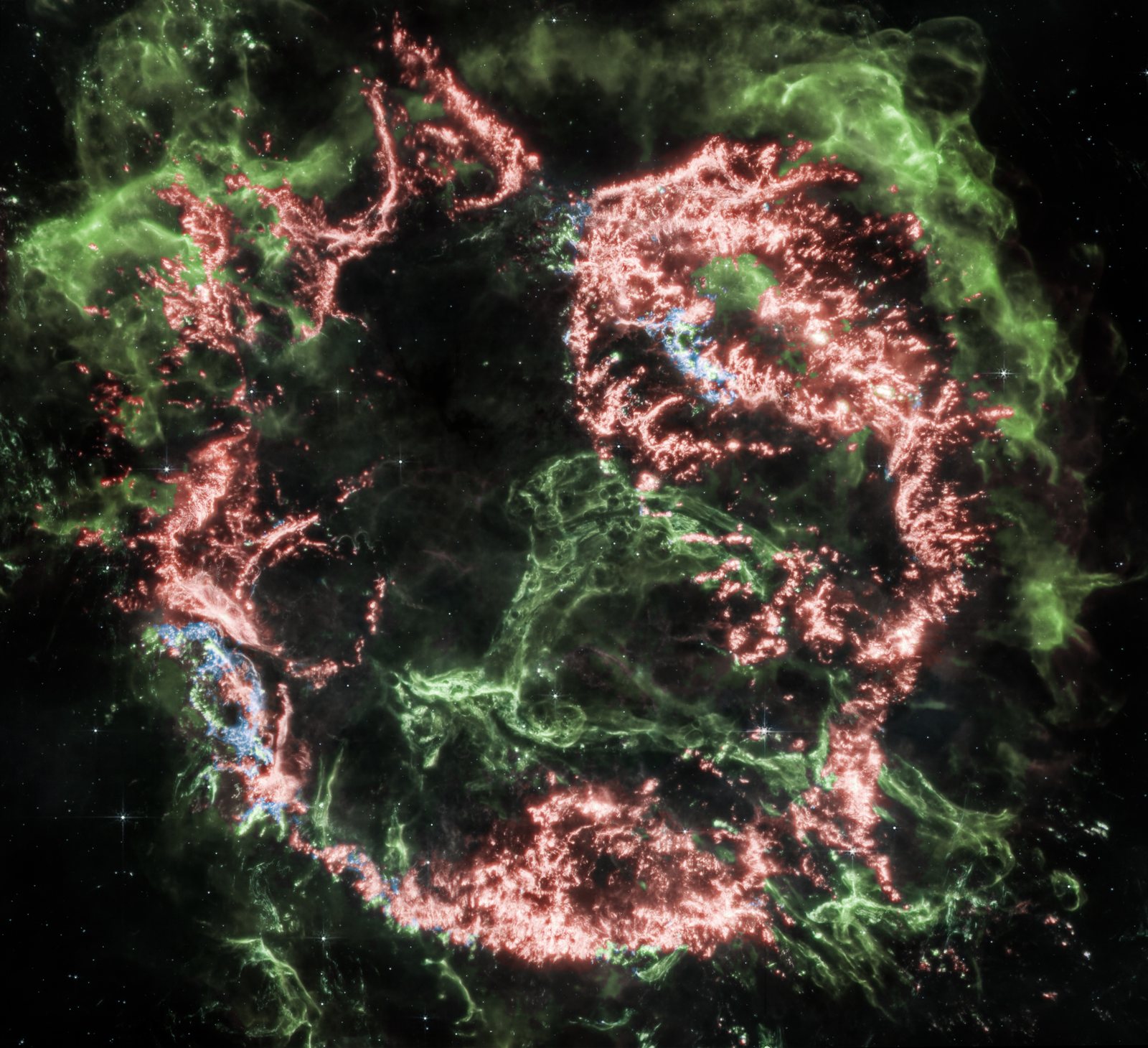
The full Webb dust map. The field is about 24 light-years across, according to NASA. Credit: NASA, ESA, CSA, STScI, Tea Temim (Columbia University), Rick Arendt (UMBC), Dan Milisavljevic (Purdue University); image processing: Joseph DePasquale (STScI) (resized).
This isn’t a normal “pretty picture” where colours stand for filters. Each colour marks a family of dust, as listed on NASA’s image page:
Magenta/pink: silica (SiO2) dust in the star’s own debris. This is the bright, clumpy ring.
Blue: neon-rich ejecta, the regions where the paper finds carbon dust. Look for the small blue patches on the left edge and near the upper right.
Green: magnesium silicate (Mg2SiO4) in material the star shed before it exploded. That includes the outer haze and the Green Monster web across the middle.
The data behind the image are older than the headline: NASA’s image page lists the MIRI observations, from Webb program 1947, as taken on August 4, 2022, only a few weeks into Webb’s science operations. The same program produced the first Webb views of Cas A released in 2023. Spectroscopy takes far longer to analyse than imaging, which is why the dust chemistry is only being published now.
Spitzer (left) found where to look; Webb (right) resolves the same area into individual clumps. Credit: NASA, ESA, CSA, STScI, Tea Temim (Columbia University), Rick Arendt (UMBC), Dan Milisavljevic (Purdue University); image processing: Joseph DePasquale and Alyssa Pagan (STScI) (resized).
What Is a Shell Merger? A Star’s Last-Minute Rearrangement
For most of its life a star burns hydrogen into helium in its core. A star many times heavier than the Sun keeps going: once the hydrogen is used up, the core squeezes and heats until it can burn helium, then carbon, neon, oxygen and silicon, each stage faster than the last. The process ends at iron, which cannot release energy by fusing. By then the star is built like an onion, with an iron core wrapped in nested shells, each still burning a different fuel.
Those layers are not calm. Heat rising from below makes each shell boil, the way water rolls in a pot. In the final phase, the boiling can become violent enough to break down the wall between two neighbouring shells. When the oxygen-burning and carbon-burning layers punch into each other and blend, astronomers call it a shell merger. Mixing fresh fuel into a hotter zone changes the nuclear reactions, so a star that goes through a merger produces a different blend of elements than one that does not.
Layers stay separate
The explosion throws out the shells more or less in order. Neon and oxygen stay together; silicon-rich material comes from deeper down. Models predict one particular set of element ratios.
Shells merge before collapse
Material from deep layers is stirred outward and vice versa, leaving pockets with unusual mixes, such as less neon relative to oxygen and more silicon. The dust that later forms inherits those mixes.
Shell mergers have been predicted by computer simulations for years, but they are almost impossible to catch directly: they happen deep inside a star, very close to its end. A young remnant like Cas A is one of the few places to test the idea, because the debris has not yet mixed with much surrounding gas.
Why Supernova Dust Is a Better Record Than Gas Alone
Astronomers usually weigh up the elements in a remnant by measuring the light from hot, glowing gas. The trouble is that some elements, especially silicon, magnesium and iron, readily freeze out of the gas into solid grains. Once locked in dust, they no longer show up in those gas measurements, so the totals come out too low. The new paper uses the dust itself to fill that gap.
That idea reaches well beyond one remnant. Most supernovae happen in galaxies far too distant for any telescope to resolve their dust clumps. The authors argue that a well-calibrated case like Cas A will help astronomers read the blended infrared glow of those faraway explosions, and use it to work out what kind of star blew up.
There is a bigger cosmic reason, too. Supernovae are among the main suppliers of the silicon, oxygen and other heavy elements in planets and in us. Milisavljevic told NASA that understanding how these stars mix before they explode is key to explaining which elements reach the galaxy and go on to build later generations of stars and planets.
How sure is this? The authors write that the dust results favor progenitor models with a carbon–oxygen shell merger, based on one-dimensional explosion models. That is strong supporting evidence, not a direct observation of the merger. Full three-dimensional simulations that follow a merger all the way to collapse are still rare, as the 2025 Chandra study pointed out.
The Green Monster, Explained
When Webb’s first mid-infrared picture of Cas A came out in April 2023, a curling green loop across the remnant’s centre surprised the team. They named it the Green Monster after the towering left-field wall at Fenway Park in Boston. Nothing in older images had prepared them for it.
Follow-up work published in 2024 (De Looze et al., ApJL 976, and an X-ray companion study led by Jacco Vink) showed that the Green Monster is not supernova debris at all. It is gas and dust that the star lost during a lopsided mass-loss episode before it exploded, now sitting on the near side of the remnant and riddled with small holes punched by fast-moving ejecta.
The new spectra add the missing ingredient: the Green Monster’s dust is warm magnesium silicate, and its spread across the remnant matches a circumstellar origin. That fits the broader picture of Cas A’s parent star. Analyses of the original supernova’s light, reflected off distant dust clouds as “light echoes,” show it was a Type IIb supernova (Krause et al. 2008): a star that had already shed most of its outer hydrogen before exploding. The Green Monster is part of what it shed.
Chandra, XRISM and Webb: How the Shell-Merger Case Has Built Up
Webb’s result is the third independent line of evidence pointing the same way in about 15 months. Each came from a different kind of light:
When
Telescope
What it showed
2003–2009
Spitzer (infrared)
Mapped Cas A’s dust at low resolution and later picked out the three regions Webb targeted
2008
Subaru (light-echo spectrum)
Identified the explosion as a Type IIb supernova (Krause et al., Science)
April 2023
Webb MIRI (imaging)
First Webb image; the Green Monster appears
August 2025
Chandra (X-ray)
Sato et al. find silicon-rich and neon-rich pockets that never fully blended, and estimate the mixing started within hours of collapse
December 2025
XRISM (X-ray spectroscopy)
Detects chlorine and potassium at levels that standard models struggle to explain, but that fit models with shell mergers, fast rotation or binary interaction
November 23, 2026
Webb MIRI (spectroscopy)
Dust compositions across the remnant favour a carbon–oxygen shell merger (Temim et al.)
Sources: NASA (2023 and 2026 Webb releases), Chandra photo album (August 28, 2025), Sato et al. 2025 (ApJ, arXiv:2507.07563), XRISM Collaboration 2025 (Nature Astronomy 10, 144), Krause et al. 2008, Temim et al. 2026. Spitzer operated 2003–2020; the years shown are its main Cas A campaigns.
X-rays trace the hottest gas; infrared traces the dust. When two techniques that see different material reach the same conclusion, it carries more weight than either alone. The XRISM team, though, was careful to list shell mergers as one of several possible explanations for its chlorine and potassium, and the question of how often stars go through this process is far from settled.
What This Means for Amateur Astronomers: Finding Cassiopeia A This Winter
Let’s be straight about it: you will not see anything like Webb’s picture in an eyepiece. Cas A is extremely faint in visible light. NASA’s Chandra team calls it hard to view with a backyard telescope, and most of what makes it famous glows in X-rays, infrared and radio. The good news is that it sits in one of the richest corners of the winter sky, and right now it is about as well placed as it ever gets.
Where to point
Find the W of Cassiopeia high in the north. Draw a line from Schedar (Alpha Cassiopeiae) through Caph (Beta) and keep going about the same distance; that brings you to the open cluster M52. Cas A lies 2.8° almost due south of M52, a bit more than five full-Moon widths. Using the coordinates on NASA’s image page (RA 23h 23m 24s, Dec +58° 49′), we measured these distances to nearby landmarks:
Landmark
Distance from Cas A
What a backyard telescope shows
NGC 7635, the Bubble Nebula
About 2.4° north
A faint arc around a bright star; 8 inches and a nebula filter visually, an easy smart-telescope target
M52 (open cluster)
About 2.8° north
A rich, compact cluster; good in binoculars, lovely in any telescope
Caph (Beta Cassiopeiae)
About 5.9° east
The end star of the W; naked eye
Schedar (Alpha Cassiopeiae)
About 10.5° east-southeast
Orange giant in the W; naked eye
Separations: Telescope Advisor calculation with Skyfield from catalogue positions. M52 and the Bubble Nebula fit in the same low-power field; Cas A is just south of that field.
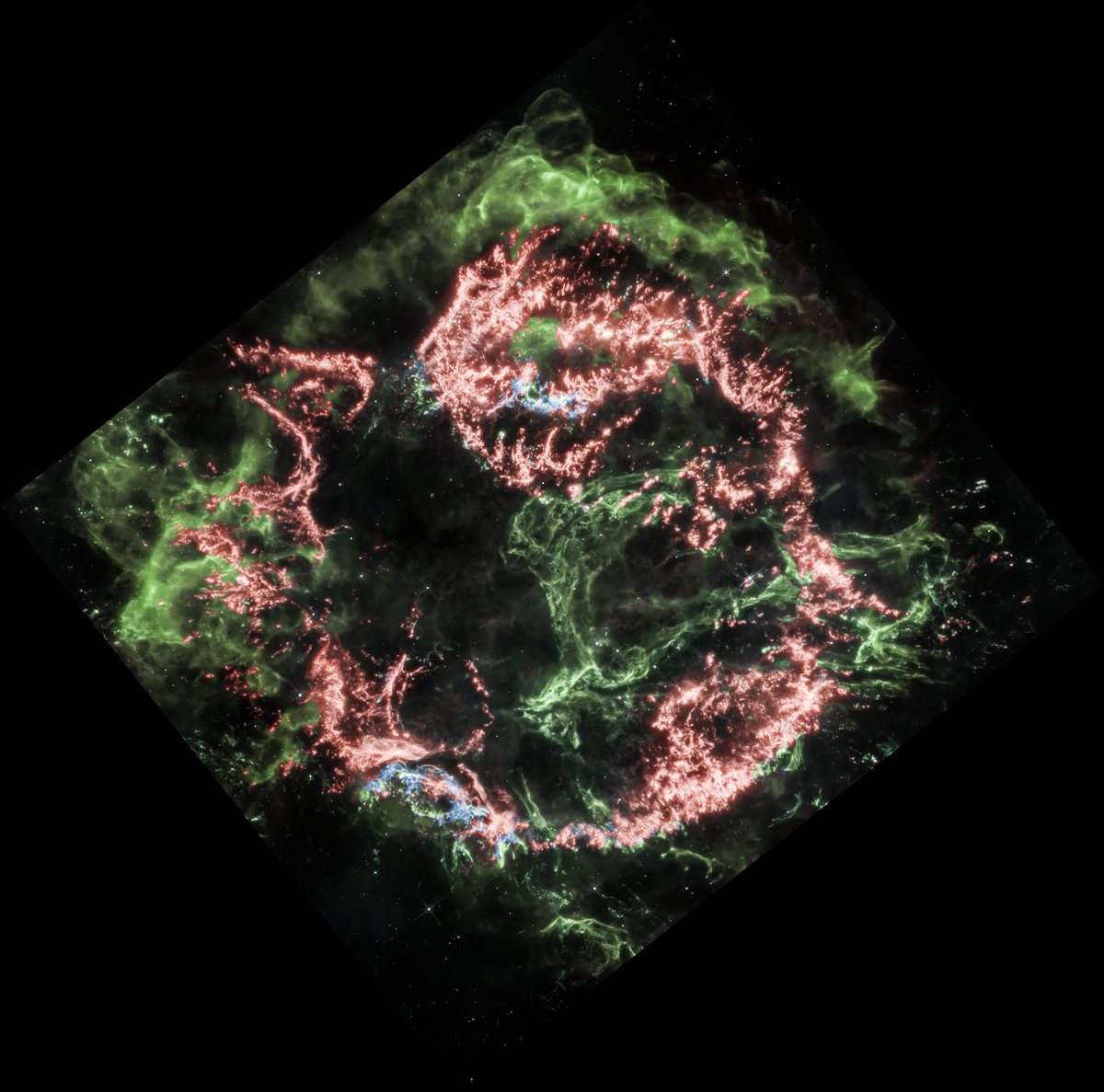
The same Webb map with north up, handy for lining up against your own images or a star chart. Credit: NASA, ESA, CSA, STScI, Tea Temim (Columbia University), Rick Arendt (UMBC), Dan Milisavljevic (Purdue University); image processing: Joseph DePasquale (STScI) (resized).
When to look: late November 2026 to early January 2027
Cas A never sets for anyone north of about 31° latitude, which covers most of the US, Canada and Europe. It is highest in the early evening this time of year:
Date
Highest point (local time, US cities)
Height at 9 p.m.
Moon
Nov 25, 2026
About 7:00 p.m., 65–73° up
58–64°, northwest
Full Moon Nov 24: bright
Dec 1, 2026
About 6:30–6:40 p.m.
55–61°, northwest
Last quarter: dark evenings
Dec 10, 2026
About 6:00 p.m.
51–57°, northwest
New Moon Dec 9: darkest
Dec 20, 2026
About 5:15–5:25 p.m., at dusk
46–52°, northwest
Waxing; full Moon Dec 24
Jan 5, 2027
About 4:15–4:25 p.m., before dark
38–44°, northwest
Waning crescent: dark
Our calculations (Skyfield, JPL DE421) for New York, Chicago, Denver and Los Angeles in standard time; Los Angeles gives the lower heights. From London, Cas A culminates about 83° high within ten minutes of the same local times. Moon phases (UTC): full Nov 24, last quarter Dec 1, new Dec 9, first quarter Dec 17, full Dec 24.
The best window is roughly November 30 to December 13, 2026, when the Moon is out of the evening sky, and Cas A is still more than 50° up at 9 p.m. Because it is circumpolar, imagers can keep collecting data on it through most of the night.
Can you photograph Cas A?
Yes, but it is a project, not a weekend snapshot. Amateurs who have captured the remnant report very long integrations, from about a day of total exposure with a 10- to 14-inch telescope and a cooled mono camera to a 525-hour campaign shared on AstroBin. They also report a quirk: unlike most nebulae, Cas A shows little hydrogen-alpha signal and comes through better in oxygen (OIII) and sulfur (SII) narrowband filters. If you have the gear, a dark sky and patience, it is one of the most rewarding deep-sky challenges in the northern sky. Our narrowband filter guide covers the filters involved.
There is another route. Cas A is one of the brightest radio sources in the sky beyond our solar system, and hobbyists have detected it with backyard dishes about two metres across and inexpensive software-defined radio receivers tuned near the 1420 MHz hydrogen band. If radio astronomy appeals to you, Cas A is a classic first target.
What you can enjoy visually tonight
Naked eye: the W of Cassiopeia, high in the north-northwest after dark, with the Milky Way running through it from a dark site.
Binoculars: M52 as a misty knot; sweep the Milky Way in Cassiopeia for star clusters such as M103 and NGC 457.
4–6 inch telescope: M52 resolves into dozens of stars; the Bubble Nebula’s bright central star is easy, the bubble itself is not.
8 inch and larger: with an OIII or UHC filter under dark skies, the Bubble Nebula’s arc becomes visible.
Smart telescope: the Bubble Nebula and the nearby Cassiopeia nebulae show up well in stacked images; Cas A itself is beyond what a short smart-telescope session can record.
For the targets around Cas A, aperture helps with the faint nebulae, a wide field helps with the clusters, and a smart telescope is the quickest way to an image of the Bubble Nebula.
Affiliate disclosure: Telescope Advisor earns a commission from qualifying Amazon purchases made through links on this page, at no extra cost to you. It never affects our recommendations.
Celestron StarSense Explorer DX 130AZ
130mm reflector whose phone app guides you to M52 and other Cassiopeia clusters.
Webb's mid-infrared spectrometer identified which kind of dust dominates each part of the Cassiopeia A supernova remnant: silica (silicon dioxide) in argon-bright debris, amorphous carbon in neon-bright debris, and magnesium silicate in the Green Monster. The team, led by Tea Temim of Columbia University, compared that pattern with supernova models and found it fits best if the star's carbon-burning and oxygen-burning layers merged shortly before the explosion. The study appeared in The Astrophysical Journal Letters on November 23, 2026.
What is a shell merger in a star?
A massive star near the end of its life is layered like an onion, with shells of different elements burning around the core. A shell merger happens when turbulent churning breaks the boundary between two of those shells, typically the oxygen-burning and carbon-burning layers, so they blend into one. That changes which elements the star produces and how they are spread out when it explodes.
How long before the explosion did the shell merger happen?
Only a short time. NASA describes the merger as underway very shortly before the supernova, and a 2025 Chandra study by Toshiki Sato and colleagues estimated the mixing began within hours of the core's collapse. Co-author Dan Milisavljevic told NASA the dust is telling the team about the final hours before core collapse.
What is the Green Monster in Cassiopeia A?
It is a filament of gas and dust that Webb spotted in its first images of Cas A, released in 2023. The team nicknamed it after the tall green left-field wall at Boston's Fenway Park. A 2024 study showed it is material the star shed before it exploded, sitting in front of the remnant. The new paper finds its dust is warm magnesium silicate, which fits that origin.
How far away is Cassiopeia A and when did it explode?
NASA gives a distance of about 11,090 light-years; a 2024 light-echo study puts it near 12,000. Light from the explosion should have reached Earth roughly in the late 1600s: Krause and colleagues (Science, 2008) estimated 327 years, give or take 19, before their 2008 observations. Studies of its light echoes show it was a Type IIb supernova from a star that had lost most of its hydrogen.
Can I see Cassiopeia A with a telescope?
Not easily. Cas A is very faint in visible light, and NASA's Chandra team describes it as hard to view from a backyard. Amateur imagers who have recorded it report many hours to hundreds of hours of exposure, with the signal strongest in oxygen (OIII) and sulfur (SII) filters. For visual observers, the easy reward is the neighbourhood: the star cluster M52 sits about 2.8 degrees north of Cas A and the Bubble Nebula about 2.4 degrees away.
Where is Cassiopeia A in the sky?
It is in the constellation Cassiopeia, the W-shaped group of stars, at right ascension 23h 23m 24s and declination +58 degrees 49 minutes. Extend the line from Schedar through Caph to reach the star cluster M52, then drop about 2.8 degrees almost due south. North of about 31 degrees latitude it never sets, and in late November it is about 60 to 65 degrees high in the northwest at 9 p.m. from most of the US, by our calculations.
Why does Webb need infrared light to study supernova dust?
Dust grains warmed by the remnant's shock waves glow mainly at mid-infrared wavelengths, and different minerals leave different fingerprints in that light, such as the 21-micron feature linked to silica in this study. Earth's atmosphere blocks most of the mid-infrared, and the earlier Spitzer telescope could not separate individual clumps. Webb's MIRI instrument provides both the wavelength coverage and the sharpness to tell one clump from the next.
Telescope Advisor calculations with Skyfield and NASA JPL’s DE421 ephemeris (transit times, altitudes, angular separations, Moon phases), November 23, 2026