Webb N159 Image: Thousands of Stars Brewing in the LMC
Telescope Advisor Logo Telescope Advisor
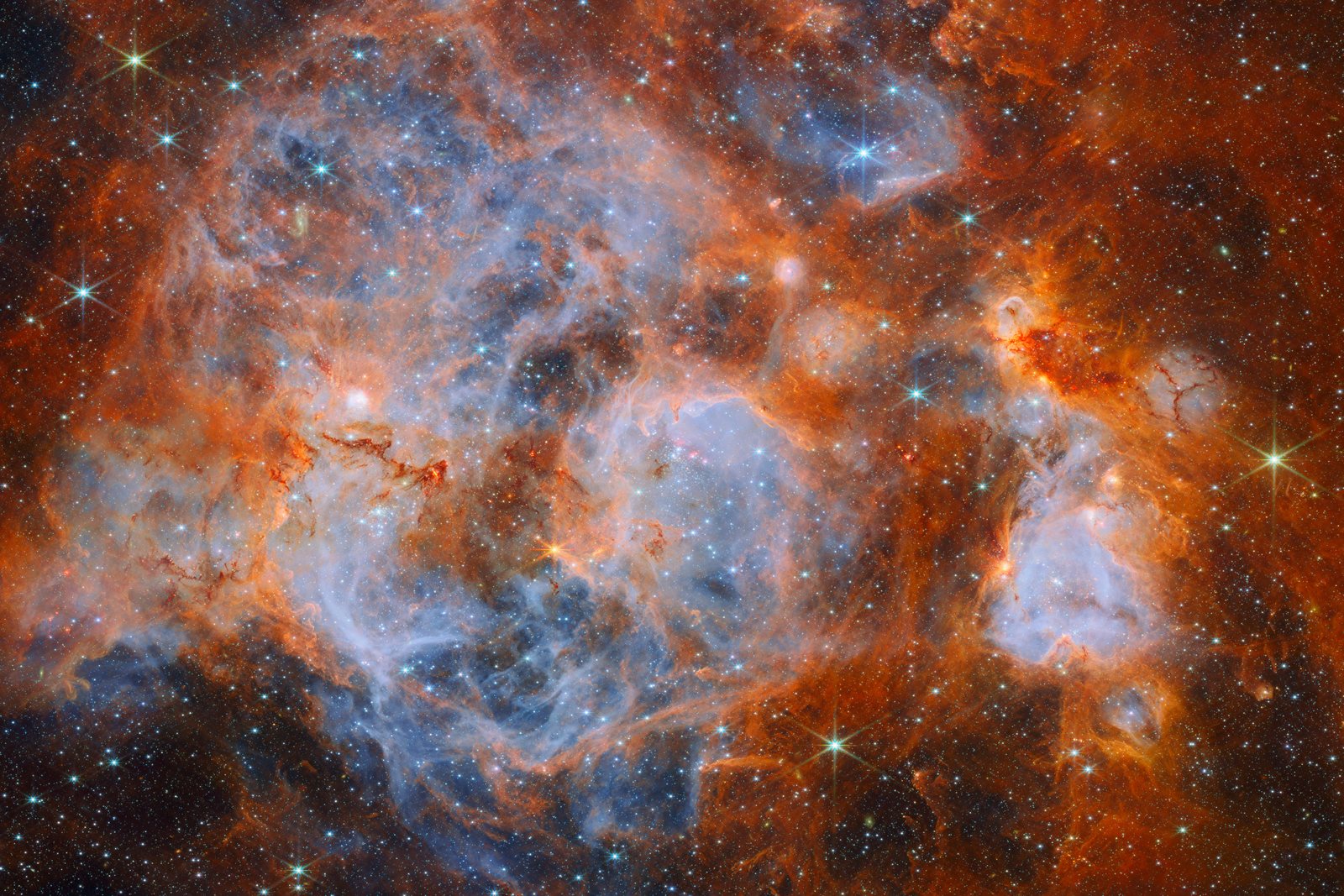
Webb NIRCam image of the N159 star-forming region in the Large Magellanic Cloud: billowing orange clouds surround pale blue bubbles of glowing gas, threaded with dark red filaments and scattered with thousands of stars

Webb Picture of the Month · Star Formation · October 2026

Webb's N159 Image: A Cosmic Cauldron Brewing Thousands of Baby Stars

161,000 light-years away, in a neighbouring galaxy, a turbulent cloud called N159 is turning gas into stars at a furious pace. The James Webb Space Telescope's newest image catches it mid-boil, and shows that the stars are switching on in waves, one side of the cloud after the other.

ObjectN159 (LMC)
Distance~161,000 light-years
InstrumentWebb NIRCam
ReleaseOctober 22, 2026
By Telescope Advisor Editorial Team Published: Updated: Reviewed & approved by Juhi Sahni, Senior Editor Editorial Standards
Elena Reyes — Senior Science Editor

Elena Reyes

Senior Science Editor

Covers NASA missions, space science discoveries, and astronomical events for Telescope Advisor. Translates complex astrophysical research into practical insights for backyard observers. Based in the San Francisco Bay Area.

Content reviewed by our editorial team. Research and drafting assisted by AI to ensure unbiased, data-driven analysis. Learn more about our editorial process.

The Short Version

  • What: A new Webb image of N159, a young star-forming cloud in the Large Magellanic Cloud, released October 22, 2026 as ESA/Webb's Picture of the Month.
  • Why it's a big deal: the science team picked out more than 300,000 point sources here, including stars less than a tenth the mass of the Sun, at a distance of 161,000 light-years.
  • The headline finding: star birth in N159 is sweeping across the cloud. The eastern side holds older, more developed stars, and the western side is packed with brand-new ones still buried in dust.
  • Why astronomers care: the Large Magellanic Cloud has fewer heavy elements than our galaxy, which makes it a stand-in for how stars formed in the early Universe.
  • Can you see it? Yes, from the Southern Hemisphere. N159 sits about two-thirds of a degree south of the famous Tarantula Nebula, and the LMC is best placed from November to February.
Full Webb NIRCam view of N159: a central cavity of pale blue ionised hydrogen ringed by thick orange clouds, dark red filaments of cool molecular hydrogen crossing the middle, a bright compact knot at left marking the Papillon Nebula, and a second blue bubble at right
N159, Webb NIRCam: a field about 230 light-years across in the Large Magellanic Cloud. Orange marks carbon-rich PAH molecules, pale blue marks hydrogen ionised by massive young stars, and the dark red filaments are cool, dense molecular hydrogen where new stars are still forming. Image: ESA/Webb, NASA & CSA, E. Sabbi, M. Zamani (ESA/Webb). Acknowledgement: M. H. Özsaraç. Licence: CC BY 4.0.

The Image: A Cauldron in Another Galaxy

On October 22, 2026, the European Space Agency's Webb team published its October Picture of the Month, titled "Stars brewing in a nebulous cauldron." It shows N159 (catalogue name LHA 120-N 159), a giant cloud of gas and dust in the Large Magellanic Cloud, a small satellite galaxy orbiting our own Milky Way. The James Webb Space Telescope is a joint mission of NASA, ESA and the Canadian Space Agency, and this view was taken with its Near-Infrared Camera, NIRCam.

The first thing you notice is how alive it looks. Thick orange clouds billow around the edges like smoke. In the middle, pools of pale blue gas glow where the youngest, hottest stars have blown cavities in the cloud. Dark red threads run through the whole scene, and those threads are where the action is: they're the densest, coldest parts of the nebula, and they're full of stars that haven't finished forming yet.

Now think about the distance. The light in this picture left N159 about 161,000 years ago, long before our ancestors spread out of Africa. And yet Webb is sharp enough to separate individual stars in it, including newborn stars so faint and small they're less than a tenth the mass of our Sun. Ten years ago, nobody could have taken this picture.

The image isn't just pretty. It comes from Webb observing programme #5114, which was designed to compare stars at different stages of development across this one nebula. The first scientific results were posted as a preprint in September 2026 by a team led by Nolan Habel, with Elena Sabbi (who is also credited on the image) as second author. What they found is the most interesting part of the story, and we'll get to it below.

N159 by the Numbers

Here's the release and the research paper boiled down to the figures that matter.

161,000 ly

Distance from Earth. N159 lies in the Large Magellanic Cloud, in the southern constellation Dorado.

~230 ly

Width of the area in the image. On the sky it covers 5.04 by 3.36 arcminutes, about a sixth of the full Moon's width.

300,000+

Point sources the science team measured across the region, the overwhelming majority of them stars.

< 0.1 M☉

The faintest stars detected are less than a tenth the mass of the Sun, at about magnitude 27 in Webb's F115W filter.

< 3 million yrs

Age of N159, making it one of the youngest star-forming regions in the LMC. Some stars here appear younger than 500,000 years.

10 filters

NIRCam wavelengths combined into the image, from 1.15 to 4.7 microns, each tuned to a different gas, molecule or type of star.

Sources: ESA/Webb potm2610a release; Habel et al. 2026, arXiv:2609.27126. The full-resolution original is 9,694 × 6,463 pixels.

Where Is N159, and Why the LMC Matters

The Large Magellanic Cloud (LMC) is one of the Milky Way's closest galactic neighbours. From a dark site in the Southern Hemisphere it looks like a detached piece of the Milky Way hanging in the sky, a pale smudge easily visible to the naked eye. It's packed with star-forming regions, and astronomers catalogue its glowing gas clouds with "N" numbers. N159 is one of them, sitting just south of the LMC's most famous object, the Tarantula Nebula, which Webb photographed in 2022.

So why point the most powerful space telescope ever built at a cloud in another galaxy, when there are star-forming regions much closer to home like the Orion Nebula? There are three good reasons.

1. It's a window on the early Universe

The LMC has significantly lower metallicity than the Milky Way, meaning a smaller share of elements heavier than hydrogen and helium (roughly half the Sun's level). The first galaxies were similarly poor in heavy elements. Watching stars form in the LMC is the closest we can get to watching star birth in the young cosmos up close.

2. Everything is at the same distance

Inside the Milky Way, working out how far away each star is takes a lot of effort. In the LMC, every star in N159 is effectively 161,000 light-years away, so how bright a star looks tells you directly how bright it really is. That makes it much easier to work out masses and ages.

3. We see it from outside

Our view of Milky Way nurseries looks through the dusty disc of our own galaxy. The LMC is seen from above, with far less dust in the way, so Webb gets a cleaner look at the whole complex at once.

Technically, N159 is an H II region: a cloud of hydrogen that has been ionised, with its electrons stripped away, by ultraviolet light from very hot young stars. The LMC has many of these. Webb has already shown us the Tarantula Nebula and another LMC region called N79. N159 adds a younger, more tangled example to the collection, and one where several stages of star formation are happening side by side.

Reading the Colours: Orange, Blue, and Dark Red

Webb sees infrared light, which is invisible to human eyes. To make a picture, image processors assign a visible colour to each infrared filter. That means the colours aren't what you'd see if you flew there, but they aren't arbitrary either. Each one traces something physical. (If you've ever wondered why nebulae look grey through an eyepiece, our explainer on seeing colour in nebulae through a telescope covers it.)

Orange: Carbon-Based Molecules (PAHs)

The thick, smoky orange clouds come from polycyclic aromatic hydrocarbons, carbon-based molecules similar to soot. They glow in infrared when starlight heats them, so they outline the dusty surface of the cloud. Webb's 3.35-micron filter is tuned to pick them up.

Pale Blue: Hydrogen Ionised by Massive Stars

The blue pools are clouds of ionised hydrogen, lit by intense ultraviolet light from the most massive young stars. These are the cavities that stellar radiation and winds have already cleared. Thin, wispy blue layers run through the centre and the left side of the image.

Dark Red: Cool Molecular Hydrogen, Where Stars Are Born

The dark red filaments crossing the centre, most visible above the blue region on the right, are cool molecular hydrogen. They're the densest parts of the nebula. They shield the stars forming inside them from the harsh radiation and winds outside. Look closely and you'll see points of light inside these filaments and in small orange pillars poking into the blue bubbles. Those are stars in the making.

The Ten Filters Behind the Picture

WavelengthWhat it traces
1.15 µm and 1.4 µmStarlight, the faintest low-mass stars
1.87 µm (Paschen-alpha)Hot hydrogen gas, and young stars still pulling in material
2.1 µm (methane band)Separating cool, low-mass objects from hotter stars
2.12 µm and 4.7 µm (molecular hydrogen)Cool H₂ gas in the dense filaments
3.0 µmWater-ice absorption in embedded young stars
3.35 µm (PAH)Carbon-rich molecules on cloud surfaces
3.6 µm and 4.6 µm (CO)Warm dust, carbon monoxide, deeply buried stars

Filter list from the ESA/Webb release. The "what it traces" column is our plain-language summary of each filter's standard use.

The Science: Stars Forming in Waves

The research behind this image, a study of N159's near-infrared star populations led by Nolan Habel (arXiv:2609.27126), was posted on September 22, 2026. Note that it's a preprint: it hasn't yet appeared in a peer-reviewed journal, so the details may be refined. Here's what the team reports.

A Census Down to Tiny Stars

Using ten NIRCam filters, the team measured more than 300,000 point sources across a complex roughly 130 parsecs (about 420 light-years) wide. The faintest detections reach magnitude 27 in the F115W filter. At the LMC's distance, that means stars of less than 0.1 solar masses, the size of the smallest true stars. Seeing stars that small in another galaxy is new territory.

Sorting the Young From the Old

By plotting the stars' colours against their brightness, the researchers separated fully developed main-sequence stars from young ones still settling down. Some of the youngest appear to be less than 500,000 years old. On cosmic timescales, that's a newborn: our Sun is about 4.6 billion years old.

Stars Caught Feeding

Some young stars glow unusually brightly in the Paschen-alpha line of hydrogen. That excess is a sign of accretion: gas falling onto the star from a surrounding disc. These stars aren't finished. They're still growing.

Ice Around Embryonic Stars

The team also found young stellar objects (YSOs) with strong infrared excess, meaning they're wrapped in warm dust. Some show water-ice absorption, so these stars are still buried in icy cocoons. The YSOs trace the dust filaments and molecular gas, which confirms they're still sitting in the material they formed from.

The Big Result: Star Birth Is Moving Across the Cloud

When the team mapped where each type of star sits, a pattern appeared. The eastern part of N159 hosts more evolved stars, while the western part is crowded with newer ones. ESA notes that the west has more young stellar objects, packed more tightly together, which suggests that side is at an earlier stage of collapse. In other words, star formation didn't happen all at once. It has moved across the cloud like a wave. Astronomers call this sequential star formation, and N159 is now one of the clearest examples of it ever mapped star by star.

Why does that matter? A central question in astronomy is whether one generation of stars triggers the next: whether radiation and winds from early stars squeeze nearby gas until it collapses too. N159 lets astronomers see several stages of that process in a single frame, from finished stars to embryos still wrapped in ice. ESA describes it as a good place to watch a molecular cloud collapse in real time.

The Papillon Nebula: Hubble's 1999 Mystery Blob

On the left side of Webb's image, look for a small, bright spot. That's the Papillon Nebula ("papillon" is French for butterfly). It's a very compact blob of ionised hydrogen thought to be connected to the formation of a massive star.

The Hubble Space Telescope first resolved the Papillon's structure in 1999, showing it as a tiny two-lobed shape, the "wings" that gave it its name. In 2025, Hubble went back and imaged the eastern and western halves of N159 in visible light. Put those views next to Webb's and you can see the whole N159 story across almost three decades of space telescope history.

The two telescopes do different jobs. Hubble, with its 2.4-metre mirror tuned mainly for visible and ultraviolet light, shows the glowing surfaces of the clouds beautifully but can't see far into them. Webb's 6.5-metre mirror and infrared instruments see through much of that dust, which is how it found the hidden young stars embedded in the filaments. For a closer look at how the two observatories (and the upcoming Roman telescope) compare, see our Roman vs Hubble vs Webb explainer.

How Massive Stars Stir the Pot

ESA's "cauldron" nickname is apt, because nothing in this picture is calm. Here's the life cycle that produces the scene, in four steps.

Step 1: The Cloud Collapses

Giant clouds of cold hydrogen are unstable. Gravity pulls denser clumps inward, and each collapsing clump becomes a protostar: hot and glowing, but not yet fusing hydrogen. This is happening now inside N159's dark red filaments.

Step 2: Giants Switch On

A few of the new stars are very massive and extremely hot. They pour out ultraviolet light that strips electrons from the surrounding hydrogen, and the ionised gas glows. That's what makes N159 an emission nebula, and it's the source of the pale blue.

Step 3: Winds Carve Bubbles

Massive stars also blow powerful stellar winds. Those winds push the gas outward, carving the ridges and cavities you can see throughout the image, and leaving bright, dense star clusters sitting inside the bubbles.

Step 4: The Fog Lifts

Over time, the filaments will evaporate and disperse, leaving the finished stars behind as an open cluster. N159 is caught in the middle of this process, which is exactly why it's so useful to study.

If this sounds familiar, it's the same basic sequence Webb has shown in Milky Way nurseries this year, including the stellar jets of NGC 7129, the "Treasure Chest" in the Carina Nebula and the brown dwarfs of IC 348. What's different about N159 is the setting: a galaxy with fewer heavy elements, much more like the conditions in which the Universe's first generations of stars were born. For a primer on the different kinds of glowing clouds, see what is a nebula?

What Comes Next for N159

The October image is the first public look at programme #5114, not the last word. The Habel et al. paper describes itself as initial results, and it's still a preprint, so expect refinements once it goes through peer review. With hundreds of thousands of measured stars in the catalogue, follow-up work can test the sequential-formation picture in much finer detail: how fast the wave of star birth is moving, and whether the massive stars on the eastern side are really what's pushing the western side to collapse.

ESA/Webb also published a wide view of N159, a pan video, a zoom video, and an episode of its short Space Sparks video series dedicated to the region, all linked in the sources below. If you want to explore the image yourself, the full-resolution version is 9,694 by 6,463 pixels. Zoom into the dark red filaments and the small orange pillars pushing into the blue bubbles, because that's where the newest stars are hiding.

The bigger picture: each of these Webb nurseries is a data point in one of astronomy's oldest questions, which is how a cold, dark cloud of gas becomes a cluster of shining stars. N159 adds one taken in a lower-metallicity galaxy, about as close as we can get to the conditions of the early Universe.

What This Means for Amateur Astronomers: How to See N159

Here's the catch: N159 sits at a declination of about −69°45′, deep in the southern sky. Whether you can see it depends almost entirely on where you live.

Who Can See It

From Australia, New Zealand, South Africa, South America and the southern tropics, the Large Magellanic Cloud is high and easy, and from much of that region it never sets. In the northern tropics it skims the southern horizon. From the continental US, Canada, Europe, and most of Asia it never rises. The LMC is best placed in the evening from November through February, so the timing of this release is perfect for southern observers.

Finding It

Start with the LMC itself, visible to the naked eye from a dark site. Find the Tarantula Nebula (30 Doradus), the brightest knot of nebulosity in the LMC and visible to the eye on good nights. N159 lies roughly 40 arcminutes south of the Tarantula's core, a bit more than the width of a full Moon. Its coordinates are RA 05h 39m 53s, Dec −69° 45′ 16″. A planetarium app makes the final hop easy; see our best astronomy apps.

What You'll Actually See

Be realistic. Through a telescope, N159 is a small, faint, grey patch of nebulosity on the LMC's rich star field, nothing like Webb's orange-and-blue infrared portrait. The reward is knowing what you're looking at: a cloud in another galaxy where hundreds of thousands of stars are being born, with your own eyes.

Equipment That Works

An 8-inch or larger Dobsonian under dark southern skies is a good match. A UHC or O-III filter helps emission nebulae like this one stand out; our narrowband filter guide explains the options. A low-power, wide-field eyepiece lets you fit the Tarantula and N159 in one view. For imaging, see astrophotography for beginners.

In the Northern Hemisphere? Try These Instead

You can still see the same physics at work. The Orion Nebula (M42) is the classic H II region and climbs into the evening sky from late autumn. In summer, try the Lagoon Nebula (M8) and the Swan Nebula (M17). Our guide to the best telescopes for viewing nebulae will help you choose a scope for them.

Frequently Asked Questions

What is N159?

N159 (also catalogued as LHA 120-N 159) is a young star-forming region, specifically an H II region, in the Large Magellanic Cloud, about 161,000 light-years from Earth in the constellation Dorado. It is less than three million years old and contains thousands of stars in the earliest stages of formation.

When was the Webb image of N159 released?

ESA/Webb released the image on October 22, 2026 as its Picture of the Month, under the title "Stars brewing in a nebulous cauldron" (image ID potm2610a). The James Webb Space Telescope is a joint mission of NASA, ESA and the Canadian Space Agency.

What did Webb discover in N159?

A team led by Nolan Habel measured more than 300,000 point sources in N159, detecting stars less than a tenth the mass of the Sun and some younger than 500,000 years. They found that the eastern side holds more evolved stars and the western side holds newer, still-embedded ones, evidence that star formation has swept across the cloud in sequence. The results are in a September 2026 arXiv preprint.

What do the colours in the N159 image mean?

Orange shows polycyclic aromatic hydrocarbons (PAHs), carbon-based molecules on the surfaces of dusty clouds. Pale blue shows hydrogen ionised by ultraviolet light from massive young stars. Dark red filaments are cool, dense molecular hydrogen, the parts of the cloud where new stars are still forming.

What is sequential star formation?

Sequential star formation is when stars form in successive waves across a cloud rather than all at once. Older stars on one side may help compress gas nearby, so later generations form next to them. In N159, older stars sit in the east and the youngest embedded stars are concentrated in the west.

Why study star formation in the Large Magellanic Cloud?

The LMC has significantly lower metallicity than the Milky Way, meaning fewer elements heavier than hydrogen and helium. That resembles conditions in the early Universe, so the LMC lets astronomers study early-Universe-style star formation up close. Because all its stars are at roughly the same distance, their true brightness, mass and age are also easier to work out.

What is the Papillon Nebula?

The Papillon Nebula is a very compact blob of ionised hydrogen inside N159. Astronomers suspect a massive star is forming within it. Hubble first resolved it in 1999, and its two-lobed, butterfly-like shape gave it the name "papillon," French for butterfly. It appears as a bright spot on the left side of Webb's image.

Can I see N159 with a backyard telescope?

Yes, if you live in the Southern Hemisphere or the tropics. N159 is about 40 arcminutes south of the Tarantula Nebula in the Large Magellanic Cloud and shows as a faint grey patch in an 8-inch or larger telescope under dark skies. It never rises from the continental US, Canada or Europe. The LMC is best placed in the evening from November to February.


Continue Exploring

Keep the session going with the next useful answer

Choose the next page based on whether you need a recommendation, a comparison, or a practical observing plan.

Use Finder Tool →

🎄 Holiday season: Telescope Christmas Gift Guide 2026 · Black Friday deal tracking

More Webb News & Related Guides