Star Merger in Andromeda Galaxy: How Webb Helped Decode Bao
Telescope Advisor Logo Telescope Advisor
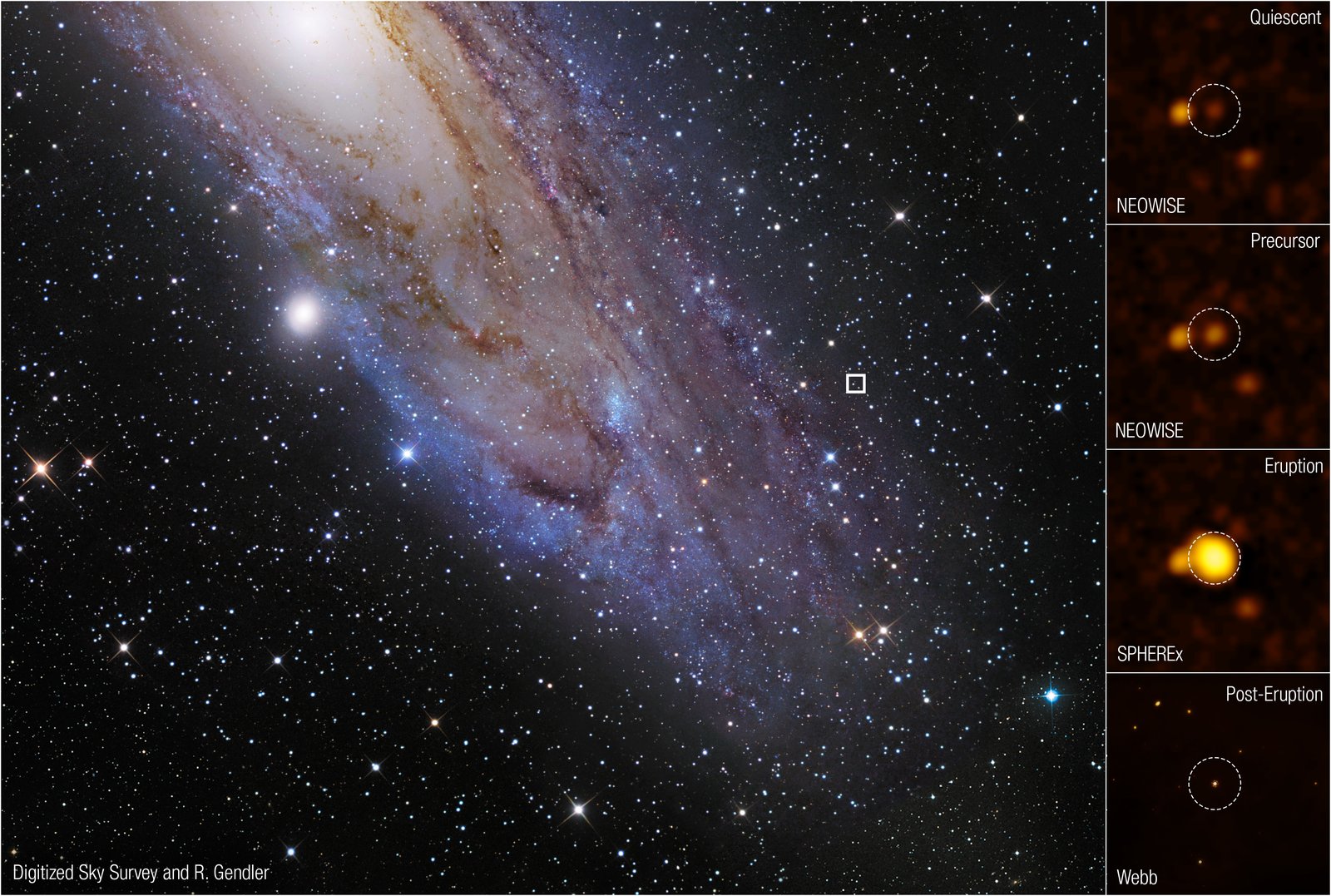
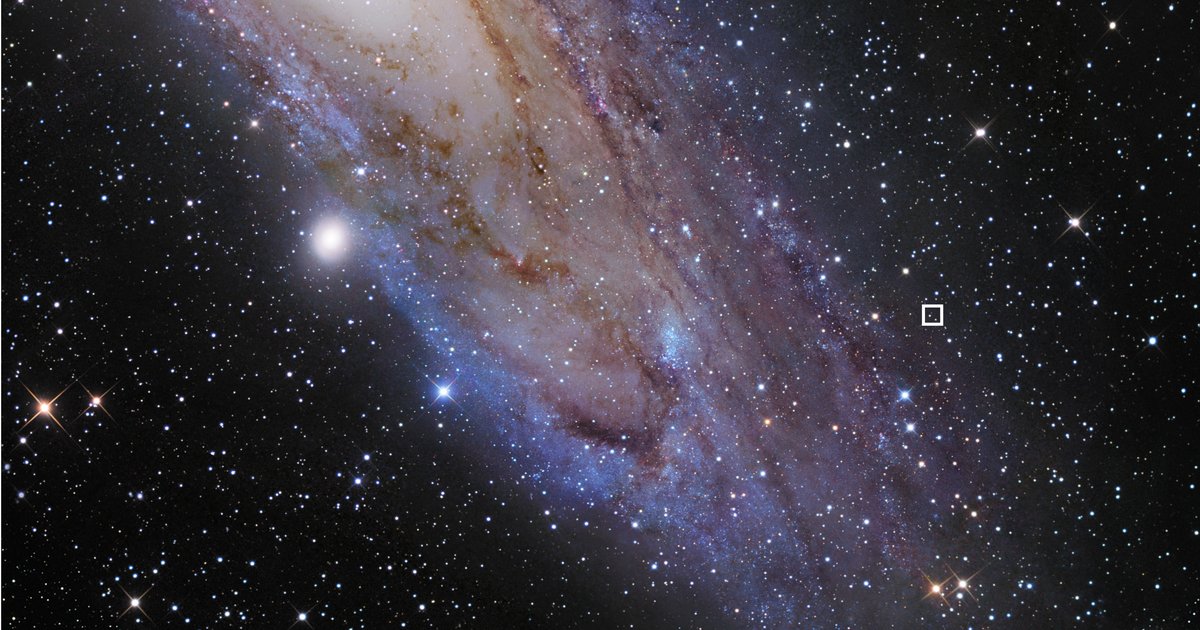
The south-western part of the Andromeda Galaxy, with its bright core at top left, the small elliptical galaxy M32 as a fuzzy white ball, and a white box marking the position of the star merger AT 2025abao on the right

NASA Webb · Space News · November 18, 2026

Star Merger in the Andromeda Galaxy: How Webb Helped Decode “Bao”

For seven years a roughly Sun-sized star sank deeper into the swollen atmosphere of a giant partner 2.5 million light-years away, until the pair erupted in October 2025. A Nature paper published on November 18, 2026 reconstructs the whole sequence, with a key infrared check from the James Webb Space Telescope. Here is what happened, what is still argued over, and where the event sits in a galaxy you can see from your backyard.

Giant star~7 solar masses
Companion~0.7 solar masses
Eruption foundOct 17, 2025
Webb lookDec 24, 2025
Distance~2.5 million ly

The box marks AT 2025abao in the Andromeda Galaxy. Credit: NASA/ESA/CSA/STScI with V. Karambelkar and K. De (Columbia University); processing by A. Pagan (STScI); background galaxy image courtesy of DSS and R. Gendler (cropped).

By Telescope Advisor Editorial Team Published: Updated: Reviewed & approved by Juhi Sahni, Senior Editor Editorial Standards

Juhi Sahni — Senior Editor, Space News, Telescope Advisor

Juhi Sahni

Senior Editor, Space News

Telescope Advisor

Senior Editor at Telescope Advisor, overseeing space news coverage and holding editorial responsibility for everything published on the site. Coverage includes NASA and ESA mission updates, JWST and Roman Space Telescope findings, sky-event guides, and equipment analysis that ties space science back to practical observing. Every factual claim is verified against primary sources — NASA/JPL Horizons, the International Meteor Organization, the US Naval Observatory, and mission briefings — before publication. LinkedIn →

The Short Version

  • The event: AT 2025abao, nicknamed Bao, is a binary star on the south-western edge of the Andromeda Galaxy (M31). A team led by Viraj Karambelkar (Columbia University) reports in Nature that a companion of about 0.7 solar masses spiralled into a giant of about 7 solar masses and merged with its core.
  • Why it is new: the slow inward spiral, a stage called common envelope evolution, had been predicted for decades but never watched directly. Here the team followed it for about seven years before the October 2025 eruption, then measured the aftermath.
  • Webb’s part: a three-hour mid-infrared observation on December 24, 2025, 47 days after peak brightness according to NASA, mapped the dust around the system and pinned down the simulations.
  • Not fully settled: the lead author says a surviving tight pair cannot yet be ruled out, and an independent study accepted by The Astrophysical Journal Letters argues the companion is still orbiting.
  • For observers: Bao itself is far too faint for the eyepiece now, but its home galaxy is high overhead on November and December evenings, and the event sits about 20′ from NGC 206, a star cloud that 8-inch and larger telescopes can show from a dark site.

What Happened to Bao, the Merging Star in Andromeda

The system began as an ordinary-looking pair: a cool, bloated giant on the asymptotic giant branch (a late stage of life for a star a few times heavier than the Sun) and a much smaller partner. The research team’s models put the giant at about 7 solar masses, roughly 350 times the Sun’s radius and some 18,000 times as luminous. The partner, which the team has nicknamed “Little Bao,” came out at about 0.7 solar masses, a little lighter and fainter than our Sun. That is the first mass estimate anyone has made for it.

Once the small star grazed the giant’s outer layers, things moved fast by stellar standards. The paper describes a gradual seven-year brightening powered by friction as the companion ploughed through the giant’s convective envelope. NASA’s account says the plunge took only about seven orbits, compared with thousands of orbits for previously known mergers between two smaller stars. Co-author Karel Temmink of Radboud University, who ran the simulations, called the giant “an absolute beast of a star.”

The end came in October 2025. In the team’s reading, the companion reached the giant’s core and the energy released drove off the outermost tenth or so of the envelope at roughly ten times the giant’s escape speed, according to the paper’s abstract. Space.com and Sci.News, reporting on the study, put the ejected material at about 0.1 to 0.2 solar masses. What is left, if the merger reading is right, is a single star that NASA describes as possibly “rejuvenated”; what it will look like once things calm down is still unknown.

Key factDetailSource
NamesAT 2025abao (“Bao”); progenitor catalogued as WNTR23bzdiqNature paper, ATel #17468, Space.com
LocationSouth-west side of M31, RA 00h 38m 48.6s, Dec +40° 46′ 08″ (constellation Andromeda)NASA media page; Reguitti et al.
DistanceAbout 2.5 million light-yearsNASA, Space.com
Giant star~7 M⊙, ~350 R⊙, ~18,000 L⊙ (model values)Nature abstract (mass), NASA, Sci.News, IEEC
Companion~0.7 M⊙ (model value)Nature abstract, Space.com, Sci.News
Peak brightnessg ≈ 15.1 (absolute g ≈ −9.5)Reguitti et al., A&A 709, A25
Ejected massAbout 0.1–0.2 M⊙Space.com, Sci.News
PaperKarambelkar et al., Nature 659, 628–633, published online November 18, 2026nature.com, Sci.News

Seven Years in the Making: the Bao Timeline

Mergers are normally spotted only after the flash, so astronomers have had to work backwards from old archive images. Bao is different because the team was already watching when it blew. Their earlier paper, posted in May 2025 (arXiv:2505.09691) and later published in The Astrophysical Journal, flagged the slow brightening as a possible start of common envelope evolution months before the eruption.

DateWhat was seen
1989–2018Archive data show a steady brightness (NASA media page)
2018 onwardA slow, years-long brightening begins as the companion sinks inward
February 2023The team notices an unusual variable in NASA’s NEOWISE infrared survey data
December 17, 2023The WINTER infrared survey camera at Palomar records the source (ATel #17468)
September 2024WINTER data show the star brightening and producing dust
May 2025The team publishes its prediction of a possible common envelope phase
July 2025NASA’s SPHEREx, during routine survey work, sees the star dim in visible light and brighten in the infrared
October 17, 2025Eruption detected by the Zwicky Transient Facility (per NASA) and by amateur Koichi Itagaki at magnitude 17.8 (per ATel #17468)
Late Oct–Nov 2025Spectra from Japan’s Seimei telescope and India’s Himalayan Chandra Telescope; ultraviolet data from Swift; Gemini North monitoring begins
December 24, 2025Webb observes the system in the mid-infrared
Dec 2025–Feb 2026Follow-up with Spain’s Gran Telescopio Canarias and Gemini North as the source cools
November 18, 2026Nature paper published; NASA, STScI and partner institutions announce the result

Sources: NASA release and media pages, IEEC release, ATel #17468, Karambelkar et al. 2025 and 2026.

What the James Webb Space Telescope Added

Composite image: on the left, a colour view of part of the Andromeda Galaxy with its core, the satellite galaxy M32 and a small white box marking AT 2025abao; on the right, four small orange panels showing the same spot before the outburst and during the precursor phase in NEOWISE data, during the eruption in SPHEREx data, and after the eruption in Webb data
Bao through four instruments: quiet and then brightening in NEOWISE data, erupting in SPHEREx data, and after the outburst in Webb’s mid-infrared view. Credit: NASA/ESA/CSA/STScI with V. Karambelkar and K. De (Columbia University); processing by A. Pagan (STScI); background galaxy image courtesy of DSS and R. Gendler (resized).

Ground-based telescopes could follow the light of the eruption, but the story of how much mass the giant had lost over its life is written in cool dust, which glows in the mid-infrared, where Earth’s atmosphere gets in the way. Webb’s observation, made under a Director’s Discretionary Time program for urgent targets, took about three hours on December 24, 2025, according to NASA. NASA says that was 47 days after the eruption’s peak and the fastest follow-up yet of such an event.

The team then ran its simulations until one matched Webb’s infrared measurements of the dust shell built up over centuries. That match is what let them estimate how efficiently the companion’s lost orbital energy went into pushing the envelope away. Astronomers express this efficiency as a number called alpha; the paper’s abstract constrains it to roughly 0.01 to 0.4 for this kind of convective giant. NASA calls this the first time telescope data have been used to measure that efficiency directly, a quantity that until now was mostly a tunable knob in theoretical models.

Webb was one instrument among many. The paper draws on NEOWISE, WINTER, SPHEREx, the Zwicky Transient Facility, Swift, Gemini North, NASA’s Infrared Telescope Facility, the Gran Telescopio Canarias and India’s Himalayan Chandra Telescope, covering ultraviolet to mid-infrared light. Karambelkar told NASA he expects “a large influx of similar discoveries” once NASA’s Nancy Grace Roman Space Telescope starts its time-domain survey of the Milky Way’s central bulge.

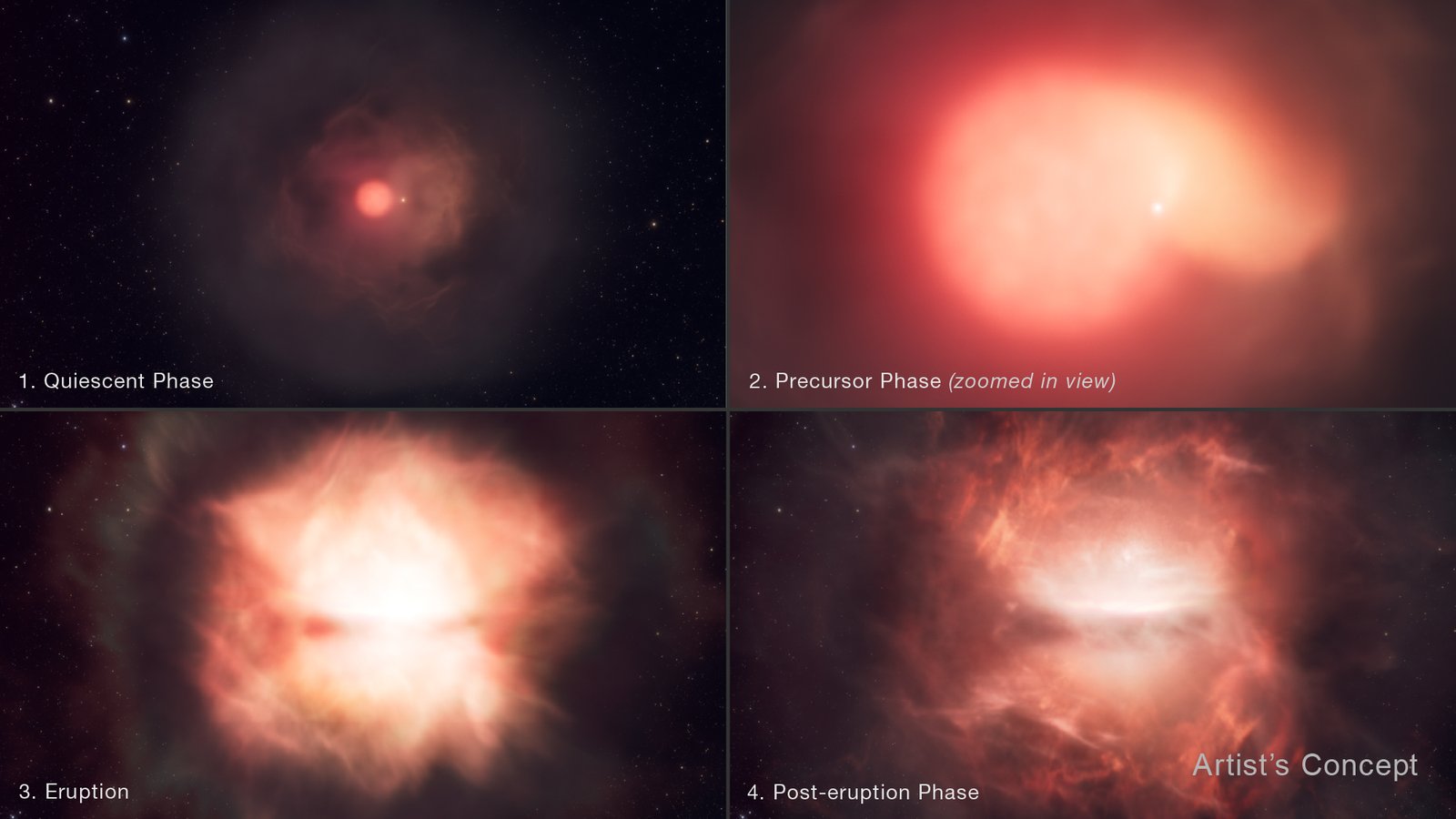
Four-panel artist's concept: a red giant and small companion inside a faint dust shell; a zoomed view of the companion inside the glowing red envelope; a bright white eruption; and an expanding cloud of gas and dust after the eruption
Artist’s concept of the four stages: quiet pair, precursor inspiral, eruption, and post-eruption outflow. Credit: NASA/ESA/CSA/STScI and L. Hustak (STScI), based on science by V. Karambelkar (Columbia University) (resized).

Common Envelope Evolution, Explained in Plain Terms

Many of the stars you see through a telescope have at least one companion. When the heavier star in a close pair runs out of hydrogen in its core, it swells to hundreds of times its former size. If the partner is close enough, it ends up inside the giant’s puffed-up outer layers, and the two stars are now orbiting within one shared cocoon of gas: the “common envelope.”

Inside that cocoon the smaller star feels drag, much like a satellite skimming Earth’s upper atmosphere. It loses orbital energy and spirals inward, and the energy it sheds heats and lifts the envelope. There are two ways this can end:

The envelope is thrown off in time

The pair survives as a much tighter binary. These are the systems that can later become X-ray binaries or millisecond pulsars, explode as supernovae, or end as pairs of neutron stars and black holes whose collisions LIGO and Virgo detect as gravitational waves.

The companion runs out of room

It sinks all the way to the core and the two become one star, with a burst of light and an outflow of gas and dust. This is what the Nature team concludes happened to Bao.

Because the phase is brief and buried inside a dusty envelope, nobody had watched the inspiral itself. Modellers had to guess how efficiently orbital energy unbinds the envelope, and that guess changes predictions for everything from supernova rates to how many black hole pairs should merge. A measured value from a real system, even a broad range, gives those models something to check against.

Merger or Survivors? The Open Question About Bao

NASA’s headline treats the merger as clinched, but the scientists are more careful. Speaking to Space.com, Karambelkar said a merger is “not the only possibility” and that both stars could have survived in a much shorter orbit; telling the two apart will take more monitoring as the debris thins out. Sci.News, summarising the study, likewise notes that future observations are needed to confirm the merger conclusively.

At least one other group reads the data differently. In a study posted to arXiv in October 2026 and accepted by The Astrophysical Journal Letters, Zhuo Chen and colleagues model the same event with a heavier companion, about 1.4 solar masses, and conclude that it and the giant’s core were still orbiting each other on an eccentric path at least 400 days after the common envelope phase began, without merging. Their model also ejects far more mass than the Nature team’s.

That kind of disagreement is normal for a first-of-its-kind object, and it is good news for the science: Bao is close enough, and well enough observed, that future infrared and spectroscopic checks should be able to tell a single swollen star from a tight surviving pair.

Status as of November 18, 2026: the merger interpretation is the conclusion of the peer-reviewed Nature paper; an independent ApJL study argues for a surviving binary. We will update this article if follow-up observations settle the question.

Bao and the Luminous Red Nova Family

Astronomers already had a name for outbursts like this one: luminous red novae. They are brighter than classical novae, dimmer than most supernovae, and turn cool and red as they fade. A team led by Andrea Reguitti, writing in Astronomy & Astrophysics earlier in 2026, classified AT 2025abao as a textbook example and the fourth luminous red nova found in the Andromeda Galaxy, with a peak absolute magnitude of about −9.5. The same paper reports the first infrared spectral energy distribution of such an object’s progenitor.

ObjectYearWhy it matters
V838 Monocerotis2002Peaked near magnitude 7 in the Milky Way; famous for the expanding light echo Hubble photographed; usually explained as a stellar merger
V1309 Scorpii2008Archive data from the OGLE survey showed a contact binary with a shrinking orbital period of about 1.4 days before the outburst, the first strong evidence that red novae come from mergers (Tylenda et al. 2011)
AT 2025abao (Bao)2025First case followed through a years-long inspiral inside a giant star, with an infrared look at the debris weeks after the peak

The difference in scale is the point. V1309 Scorpii involved two small stars in a contact binary; Bao’s primary was a giant hundreds of times the Sun’s size. Seeing both kinds of collision helps astronomers map how mergers play out across the range of stellar masses.

What This Means for Amateur Astronomers: Where Bao Sits in a Galaxy You Can See

You can’t see the merger itself in an eyepiece. At its brightest, in late 2025, AT 2025abao reached about magnitude 15.1 in green light, according to Reguitti et al., which is a job for a camera and a medium-sized telescope rather than visual observing, and it has faded since. We have not found a published current magnitude; if you want to try imaging the field, check the latest photometry on the public BHTOM target page first.

Amateurs did play a real part, though. ATel #17468 credits Japanese amateur Koichi Itagaki with reporting the outburst at magnitude 17.8 on October 17, 2025, with independent detections by Robert Fidrich and the MASTER robotic network within two days. Patrolling M31 for novae is a long-standing amateur project, and Bao is a reminder that a well-processed image of Andromeda can catch something new.

Finding the spot in M31

The Andromeda Galaxy (magnitude 3.4) is the most distant thing most people can see with the naked eye, a long smudge in the constellation Andromeda. Using the coordinates on NASA’s media page, we worked out where Bao sits relative to the galaxy’s easy landmarks:

LandmarkDistance from AT 2025abaoWhat a backyard telescope shows
NGC 206 (star cloud)About 20′ east of BaoA faint, mottled patch in M31’s south-west disk; needs about 8 inches of aperture and a dark sky
M32 (satellite galaxy)About 44′ east (nearly due east)A small, bright, round glow; easy in any telescope
M31’s coreAbout 54′ north-eastBright oval nucleus; visible in binoculars
M110 (satellite galaxy)About 58′ north-north-eastLarger, fainter elongated glow; best in 4 inches or more

Separations: our calculation from catalogue positions (Skyfield). The full Moon is about 31′ across, so Bao lies roughly one and a half Moon-widths west of M32. NGC 206 description: Sky & Telescope; size and position: NGC/IC Project.

In the colour image at the top of this page, the bluish knot of the disk about a third of the way from the white box toward M32 is NGC 206, by our match of the catalogue positions. That is the field to centre if you want your own picture of where Bao happened. A wide-field or smart telescope frames M32, NGC 206 and the event location together.

When to look: late November 2026 to early January 2027

DateM31 highest (New York, Chicago, Denver, LA local time)Height at 10 p.m.Moon
Nov 20, 2026About 8:35–8:45 p.m., 83–90° up72–75°, westBright (full Moon Nov 24)
Dec 1, 2026About 7:50–8:00 p.m., 83–90° up64–67°, westLast quarter: evenings dark
Dec 15, 2026About 7:00 p.m., 83–90° up54–57°, westWaxing Moon (39% lit) sets about 10:45 p.m.
Jan 5, 2027About 5:35–5:45 p.m., before full darkness38–42°, west-northwestWaning crescent, dark evenings

Our calculations (Skyfield, JPL DE421) for New York, Chicago, Denver and Los Angeles in standard time. From London, M31 transits within about 10 minutes of the US local times, at about 80°. Astronomical darkness begins around 6 p.m. local time in all five cities in December. Moonrise and moonset times are for New York. Moon phases: full Nov 24, last quarter Dec 1, new Dec 9, first quarter Dec 17, full Dec 24 (UTC).

The best window this year is roughly November 29 to December 12, 2026: Andromeda is near the zenith soon after dark, and the Moon either rises late at night or is a thin crescent that sets in early evening (from New York, the Moon rises after 10 p.m. from November 29 and sets before 8 p.m. through December 12). Looking straight up is awkward with a refractor or a Dobsonian, so many observers catch M31 an hour or two after it passes overhead, when it is still more than 60° high in the west.

What to expect with different gear

  • Naked eye: from a dark site, an elongated, misty glow north-east of the Great Square of Pegasus.
  • Binoculars (10x50 to 15x70): the bright core and a long, tapering disk; M32 shows as a fuzzy star beside it.
  • 6–8 inch telescope: M32 and M110, hints of dark dust lanes, and under dark skies the mottled glow of NGC 206 near Bao’s position.
  • Smart telescope or camera: a stacked image shows the disk structure and star clouds; with enough integration you can record the region around AT 2025abao, though the merger remnant itself may now be at or beyond your limit.

Step-by-step help: how to find the Andromeda Galaxy, our M31 telescope guide, and whether you can see Andromeda from a city.

Gear for Andromeda and its star clouds

A galaxy this large rewards wide fields and aperture. These are the options we point readers to most often for M31, from big binoculars to an 8-inch Dobsonian and a smart telescope for imaging.

Affiliate disclosure: Telescope Advisor earns a commission from qualifying Amazon purchases made through links on this page, at no extra cost to you. It never affects our recommendations.

Celestron SkyMaster 15x70

Celestron SkyMaster 15x70

Large astronomy binoculars that take in all of M31 with M32 and M110; steadiest on a tripod.

Sky-Watcher Heritage 130P

Sky-Watcher Heritage 130P

Compact 130mm tabletop Dobsonian with a wide field for the Andromeda Galaxy and its companions.

Sky-Watcher Classic 200P Dobsonian

Sky-Watcher Classic 200P Dobsonian

8-inch Dobsonian with the aperture to pick out M31's dust lane and, from a dark site, NGC 206.

ZWO Seestar S30 Plus

ZWO Seestar S30 Plus

Smart telescope that stacks images of galaxies like M31 from a phone app.

More help choosing: best telescopes for galaxies, best binoculars for stargazing and our telescope Black Friday guide.

Andromeda Star Merger: Frequently Asked Questions

What is the star merger in the Andromeda Galaxy?
It is a binary star system in the Andromeda Galaxy (M31), formally called AT 2025abao and nicknamed Bao. According to a Nature paper published on November 18, 2026, a companion of roughly 0.7 solar masses spiralled for about seven years through the bloated outer layers of a giant star of roughly 7 solar masses, then sank into its core, setting off a bright eruption in October 2025.
What did the James Webb Space Telescope contribute?
Webb took mid-infrared observations of Bao on December 24, 2025, which NASA says was 47 days after the eruption peaked. Those data traced the dust the giant star had shed over centuries. The team compared them with their simulations, which let them estimate how much material was thrown off and how efficiently the orbital energy did that work. NASA describes it as the earliest follow-up of this kind of event so far.
Is it certain that the two stars merged?
Not completely. The Nature team favours a merger, but lead author Viraj Karambelkar told Space.com that a surviving, much tighter pair is also possible and that more monitoring is needed. A separate team led by Zhuo Chen (arXiv:2610.05769, accepted by The Astrophysical Journal Letters) modelled the event differently and argues the companion survived in an eccentric orbit for at least 400 days after the event began.
What is common envelope evolution?
It is a short, violent phase that some close binary stars go through. When one star swells into a giant and engulfs its partner, both orbit inside a shared gas envelope. Friction drags the smaller star inward, and the energy it loses can blow the envelope away. The pair then either ends up in a much tighter orbit or merges into a single star. Astronomers think this step is needed to make many close binaries that later produce supernovae, X-ray binaries and gravitational-wave sources.
What is a luminous red nova?
A luminous red nova is a type of stellar eruption that is brighter than an ordinary nova but fainter than most supernovae, and that turns red and cool as it fades. Most are thought to come from stars merging or from common envelope episodes. Well-known examples in our own galaxy are V838 Monocerotis in 2002 and V1309 Scorpii in 2008. A team led by Andrea Reguitti classified AT 2025abao as the fourth luminous red nova found in the Andromeda Galaxy.
Can I see the star merger with my telescope?
Not today with your eyes. At its peak in late 2025 the eruption reached about magnitude 15.1 in green light (Reguitti et al.), which is a target for cameras rather than eyepieces, and it has been fading since. What you can see is its neighbourhood: the spot lies on the south-west side of the Andromeda Galaxy, about 20 arcminutes west of the star cloud NGC 206, and the whole galaxy is easy to find on autumn and early-winter evenings.
How far away is the Andromeda Galaxy?
About 2.5 million light-years, the figure NASA gives for this system. Andromeda is the nearest large spiral galaxy to the Milky Way, and at magnitude 3.4 it is visible to the naked eye from a dark site as an elongated glow in the constellation Andromeda.
When is the best time to see the Andromeda Galaxy in late 2026?
From mid-latitude northern locations, Andromeda passes almost overhead around 8 to 9 p.m. local time in late November and around 7 p.m. in mid-December, by our calculations. The darkest evenings are roughly November 29 to December 12, 2026, when the Moon either rises late or sets soon after dusk (last quarter December 1, new Moon December 9). Avoid the nights around the full Moons of November 24 and December 24.
Who discovered the eruption?
Several observers caught it within days. According to ATel #17468, Japanese amateur astronomer Koichi Itagaki reported it at magnitude 17.8 on October 17, 2025, with independent detections by Robert Fidrich and the MASTER network over the next two days. NASA credits the Zwicky Transient Facility with detecting the eruption on October 17, 2025. The research team had been watching the star since 2023.

Sources