
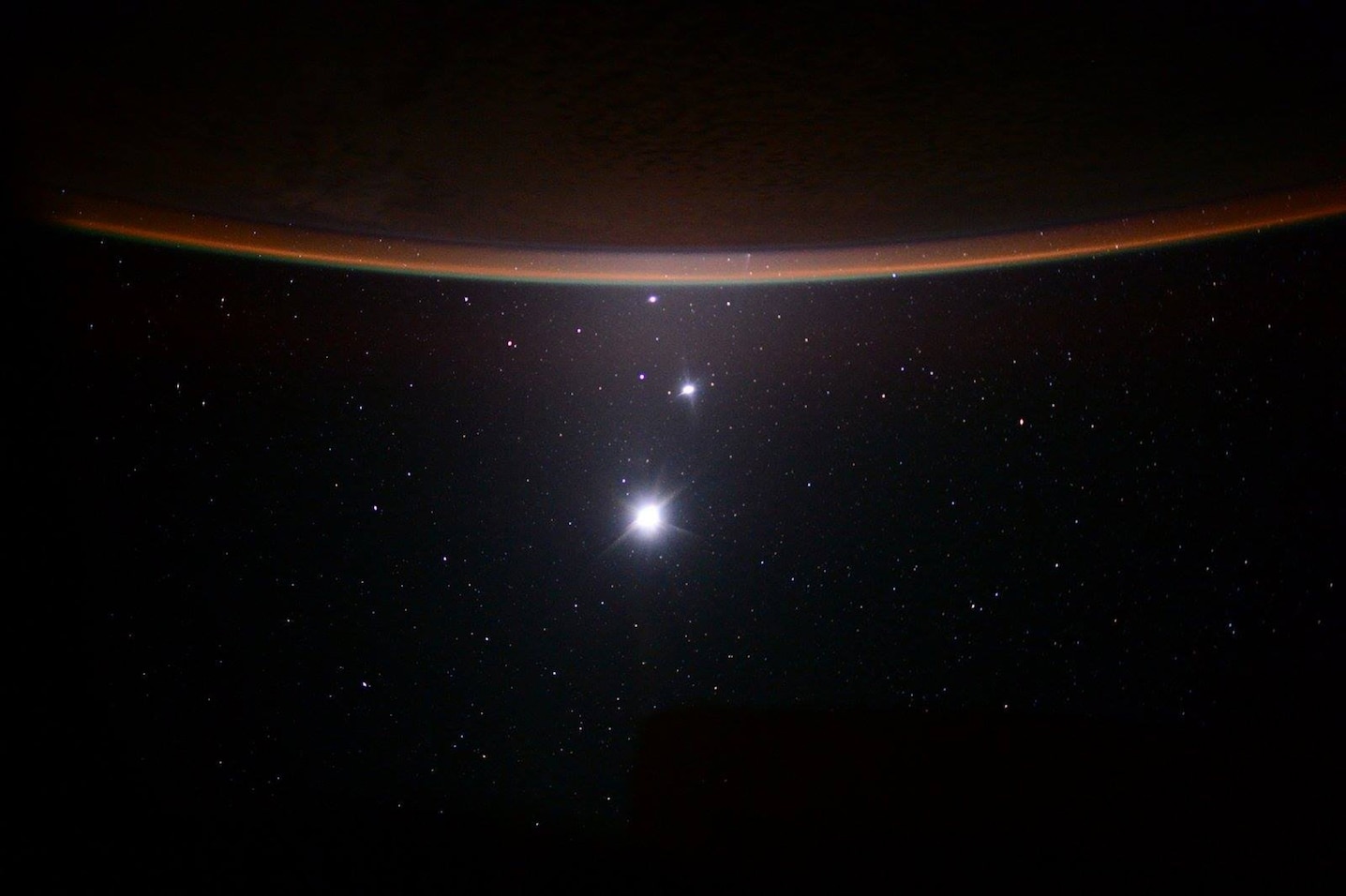

Quick Answer: Is There a Christmas Star in 2026?
- • No rare event: There is no Jupiter–Saturn “great conjunction” and no unusual planet pairing at Christmas 2026. The famous “Christmas Star” of December 21, 2020 was a once-in-a-generation event, and the next great conjunction falls in late 2040.
- • The bright “star” is Venus: At magnitude −4.7, Venus is the brightest point of light in the sky. It is a morning object, not an evening one: it rises at about 3:15–3:30 a.m. local time and stands about 25–30° up in the southeast by 6:00–6:30 a.m. on December 24 and 25.
- • Christmas Eve evening: The just-past-full Cold Supermoon rises in the east-northeast around sunset, and Saturn shines high in the south at dusk. Jupiter rises in the east-northeast at about 8:35–8:55 p.m., followed by reddish Mars about an hour later.
- • Christmas morning before dawn: Venus in the southeast, Jupiter and Mars high in the southwest, and the Moon sinking in the west. That is four of the five brightest objects in the night sky at once.
- • Got a telescope for Christmas? On Christmas night aim it first at Saturn (thin rings), then at Jupiter after about 9:30 p.m. (four moons, cloud belts). Save Venus for the next morning: it shows a half-lit phase, like a tiny Moon.
Rise times, altitudes, magnitudes and phases were computed by Telescope Advisor from the JPL DE421 planetary ephemeris with the Skyfield library for New York, Chicago, Denver and Los Angeles. We checked them against BBC Sky at Night Magazine, the Old Farmer’s Almanac and timeanddate.com (see Sources). Times are local standard time.



