Europa Clipper Earth Flyby Dec. 3, 2026: How to See Europa
Telescope Advisor Logo Telescope Advisor
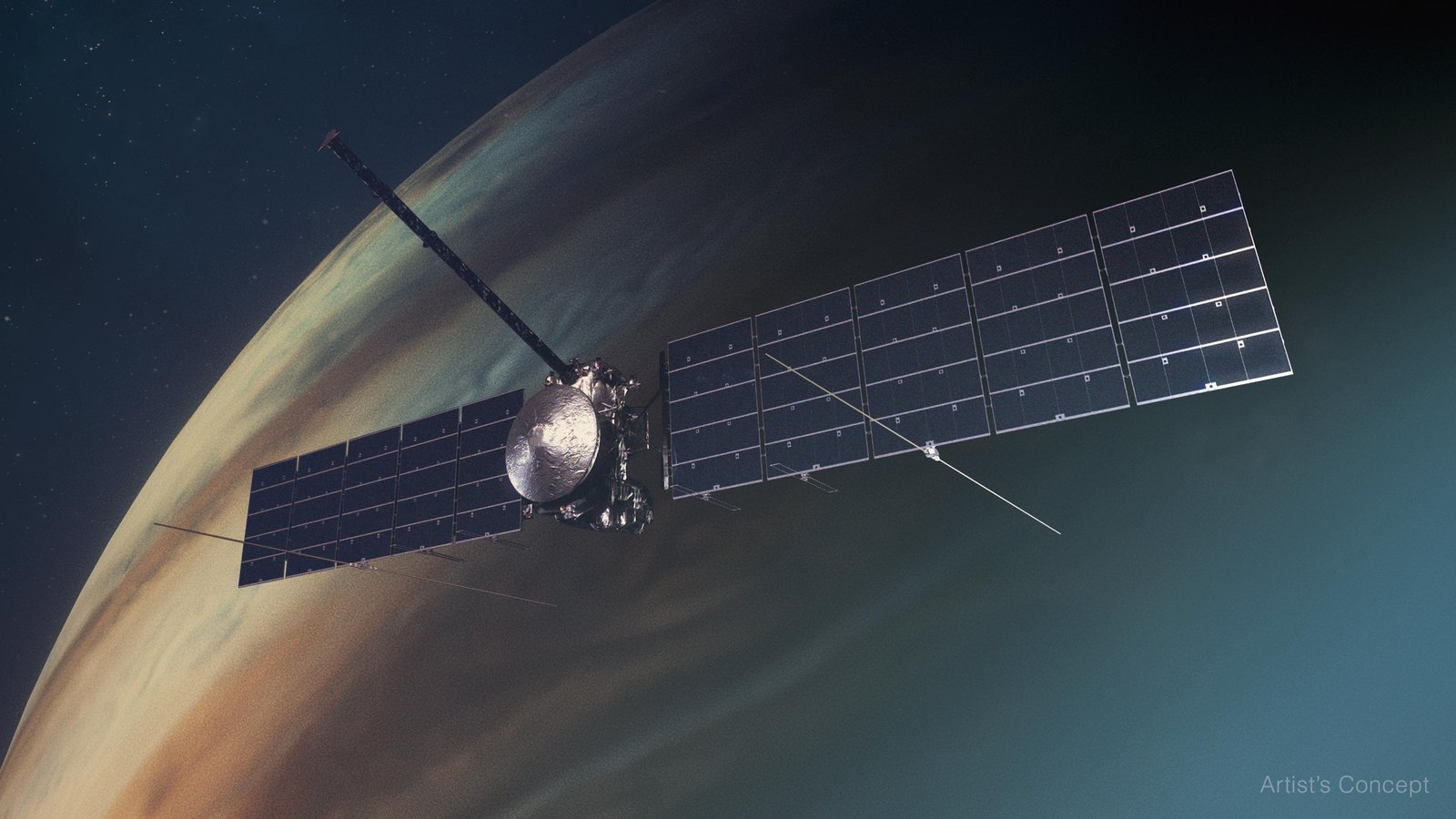
Artist's concept of NASA's Europa Clipper spacecraft, with its large high-gain dish antenna, long magnetometer boom and two wide solar-array wings, flying in front of the banded, softly lit globe of Jupiter

NASA Europa Clipper · Space News · November 21, 2026

Europa Clipper’s Earth Flyby on December 3, 2026, and How to See Europa Yourself

NASA’s Europa Clipper is scheduled to swing past Earth on December 3, 2026, dipping to about 2,000 miles (3,200 km) above the planet to steal the orbital energy it needs to reach Jupiter in 2030. Here is what the flyby does, what the science team plans to test on the way past, what happens next, and how to point a small telescope at Europa, the icy moon the spacecraft is going to study.

Earth flybyDec 3, 2026
Altitude~2,000 mi (3,200 km)
Jupiter orbitApril 11, 2030
Europa flybys49 planned
See EuropaMag ~5.8, in Leo

Artist’s concept of Europa Clipper at Jupiter (PIA26068). Credit: NASA/JPL-Caltech (resized and cropped).

By Telescope Advisor Editorial Team Published: Updated: Reviewed & approved by Juhi Sahni, Senior Editor Editorial Standards

Juhi Sahni — Senior Editor, Space News, Telescope Advisor

Juhi Sahni

Senior Editor, Space News

Telescope Advisor

Senior Editor at Telescope Advisor, overseeing space news coverage and holding editorial responsibility for everything published on the site. Coverage includes NASA and ESA mission updates, JWST and Roman Space Telescope findings, sky-event guides, and equipment analysis that ties space science back to practical observing. Every factual claim is verified against primary sources — NASA/JPL Horizons, the International Meteor Organization, the US Naval Observatory, and mission briefings — before publication. LinkedIn →

The Short Version

  • The flyby: Europa Clipper’s Earth gravity assist is scheduled for Thursday, December 3, 2026, at an altitude of about 2,000 miles (3,200 km), per NASA. It follows a Mars flyby on March 1, 2025.
  • Why: planetary slingshots save propellant. Passing close to Earth bends the spacecraft’s path and adds the energy it needs for the long climb out to the giant planet.
  • A dress rehearsal: a conference abstract by members of the science team describes plans to calibrate the magnetometer against Earth’s magnetic field and to test several other instruments during the pass.
  • What comes next: orbit insertion at Jupiter on April 11, 2030, then 49 close flybys of Europa beginning in 2031 to find out whether the moon’s hidden ocean could support life.
  • For your telescope: Europa is a magnitude 5.8 moon beside Jupiter in Leo, rising around 9 to 10 p.m. in December. We list nights when Europa or its shadow crosses Jupiter’s face.

What Happens During Europa Clipper’s Earth Flyby on December 3, 2026

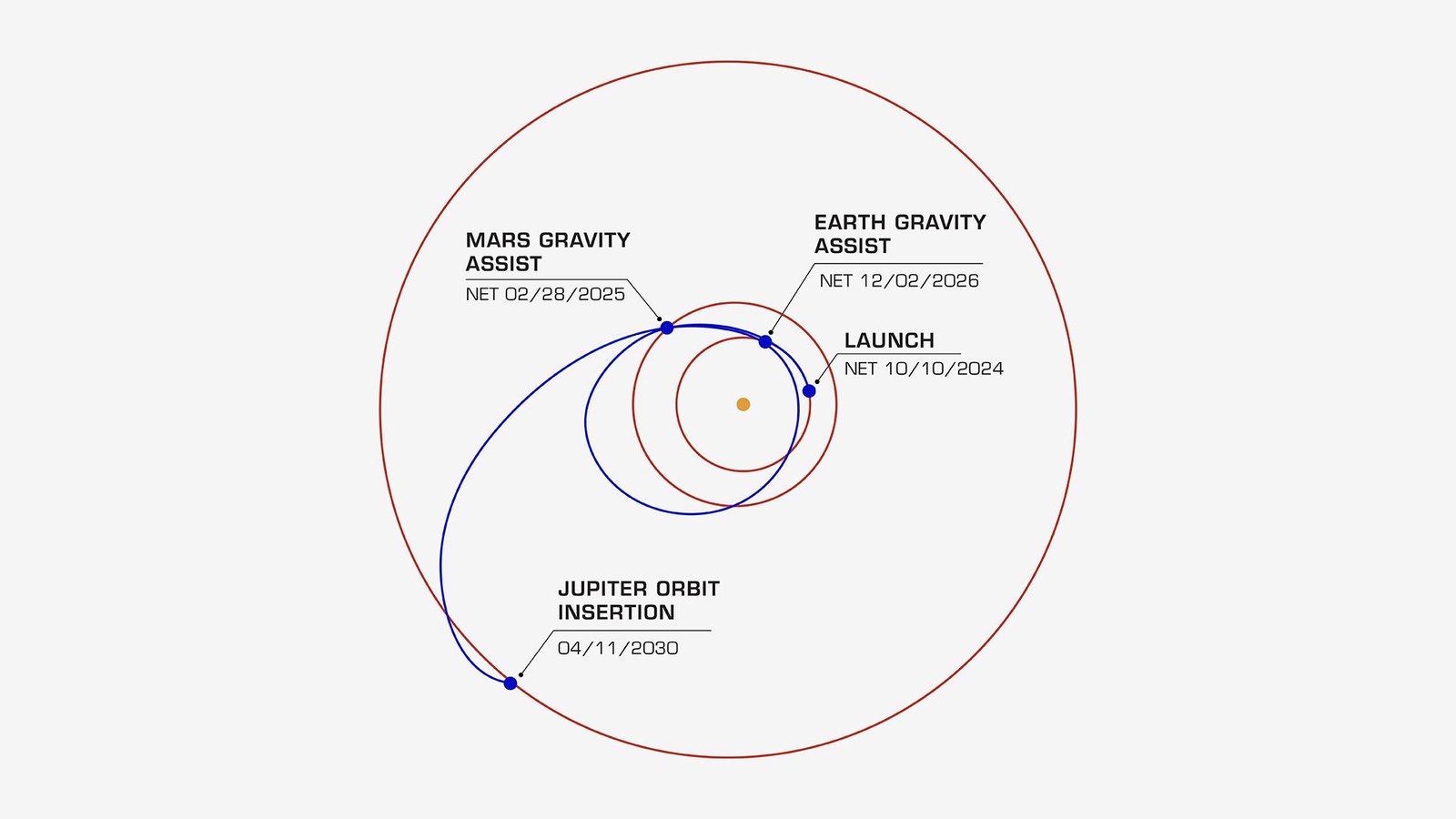
Europa Clipper left Kennedy Space Center on a SpaceX Falcon Heavy on October 14, 2024. Rather than carry the extra propellant a more direct route would need, which NASA says would have added weight and cost (or years of travel) to a spacecraft of about 6,000 kg (12,750 lb), mission planners designed a looping route that uses two planets as free accelerators. The first leg ended at Mars on March 1, 2025, when the spacecraft passed about 550 miles (884 km) above the Red Planet. That encounter actually slowed the probe relative to the Sun, from about 15.2 to about 14 miles per second by NASA’s figures, and reshaped its orbit so that it would come back around to meet Earth.

The meeting is set for December 3, 2026. NASA’s mission timeline puts the closest approach at roughly 2,000 miles (3,200 km) above Earth, a figure The Planetary Society also gives. As the spacecraft falls past our planet, Earth’s gravity swings it onto a new, larger orbit around the Sun with enough energy to reach Jupiter’s distance. In NASA’s words the two flybys together provide the energy the probe needs; the Earth pass is the last push it gets before arrival.

NASA diagram of Europa Clipper's looping route: the Sun at center, the orbits of Earth, Mars and Jupiter as red circles, and a blue path from launch, past Mars, back past Earth and out to Jupiter orbit insertion
Europa Clipper’s route to Jupiter (PIA26435). The labels show “no earlier than” planning dates from before launch; NASA’s caption for the same image gives the Earth gravity assist as December 3, 2026 and the start of Jupiter orbit as April 11, 2030. Credit: NASA/JPL-Caltech (resized).
Flyby factDetailSource
DateThursday, December 3, 2026NASA mission page, NASA Photojournal, EPSC2026 abstract
Closest approachAbout 2,000 miles (3,200 km) above EarthNASA mission timeline; The Planetary Society
Exact timeNot listed on NASA’s mission pages as of November 21, 2026—
PurposeSecond and final gravity assist; adds the energy needed to reach JupiterNASA mission timeline and 2025 Mars-flyby release
Trip lengthAbout 5½ years and 1.8 billion miles (2.9 billion km) from launch to JupiterNASA Photojournal; NASA mission page

NASA’s free Eyes on the Solar System app, which the mission page links to, lets you scrub through the encounter and watch the spacecraft’s path bend around Earth.

Instrument Checks the Team Plans During the Earth Pass

A gravity assist is mostly a navigation event, but a close pass of a well-studied planet is also a rare chance to test instruments against something known. In an abstract for the 2026 Europlanet Science Congress (EPSC2026-284), Haje Korth of the Johns Hopkins Applied Physics Laboratory and Robert Pappalardo and Bonnie Buratti of JPL describe the flyby as a fuller rehearsal of operations than the Mars pass. Their plans include, some of them listed as possibilities rather than commitments:

  • Magnetometer (ECM): an absolute calibration using Earth’s magnetic field, the only such opportunity after launch according to the abstract. At Europa, this instrument will look for the magnetic signature of a salty ocean.
  • Plasma instrument (PIMS): cross-checks against measurements made by other spacecraft near Earth.
  • Radar (REASON): possible tests using lightning over the Amazon or Africa and signals from the Owens Valley Radio Observatory.
  • Thermal imager (E-THEMIS) and ultraviolet spectrograph (Europa-UVS): possible looks at Earth and the Moon, including the cold lunar night side and Earth’s airglow near closest approach.
  • Dust and gas analyzers (SUDA, MASPEX) and radiation monitors: checkouts as the spacecraft crosses the Van Allen belts.

These are the team’s published plans as of the abstract, not results. NASA usually releases any images or data from a flyby after the event; this article will not assume what they show.

Can You See Europa Clipper as It Passes Earth?

We looked for viewing guidance from NASA and from established observing sources and found none: no published predictions of where the spacecraft will appear in the sky, how bright it might get or from where it could be seen. Without that, we will not tell you to go outside and look for it. Closest approach also depends on an exact time that NASA’s mission pages did not list when we checked.

If NASA or a reliable observing group publishes a visibility forecast, follow that. In the meantime, the far more rewarding target is the one the spacecraft is chasing. Europa is up in the late-evening sky through December, and the rest of this article shows you how to find it.

After the Flyby: Europa Clipper’s Road to Jupiter

Once Earth is behind it, Europa Clipper has no more planets to visit until it reaches its destination. The cruise from December 2026 to spring 2030 is quiet by design: periodic instrument checkouts, small course corrections and long stretches of coasting. These are the milestones NASA lists for the rest of the mission:

DateMilestone
October 14, 2024Launch on a Falcon Heavy from Kennedy Space Center
March 1, 2025Mars gravity assist, about 550 miles (884 km) above the surface
December 3, 2026Earth gravity assist, about 2,000 miles (3,200 km) up
April 11, 2030Jupiter orbit insertion: an engine burn of about six hours, with a Ganymede flyby during the maneuver
Spring 2031First Europa flyby, used to shape the orbit
May 2031First science campaign, focused on Europa’s anti-Jovian hemisphere
May 2033Second science campaign, focused on the hemisphere that faces Jupiter
September 2034Planned end of mission, with a deliberate impact on Ganymede

Sources: NASA Europa Clipper mission timeline and mission page; NASA Photojournal (PIA26435) for the April 11, 2030 date.

Europa Clipper will not be alone out there. ESA’s Juice spacecraft, which made its own Earth flyby in late September 2026, is also headed for Jupiter, where it will eventually settle into orbit around Ganymede. The two missions will study the Jovian moons from different angles in the early 2030s.

Why Europa Is Worth a 1.8-Billion-Mile Trip

Europa is about 1,940 miles (3,100 km) across, roughly 90% the size of our Moon, and it circles Jupiter every 3.5 days. Its surface is a bright, cracked shell of ice that NASA estimates at 10 to 15 miles (15 to 25 km) thick. Beneath it, scientists think, lies a global ocean of salty water that may hold more than twice the volume of all of Earth’s oceans combined.

Liquid water, chemistry and an energy source are the basic ingredients for life as we know it, and Europa may have all three. Europa Clipper is not a life-detection mission. Its job is to determine whether places under the ice could support life, by measuring the ice shell, the ocean’s depth and saltiness, the composition of the surface and any material that escapes into space. The spacecraft is large for a planetary probe: its solar arrays span more than 100 feet (about 30 meters), because sunlight at Jupiter’s distance is roughly 25 to 30 times weaker than at Earth.

To limit time in Jupiter’s intense radiation, the spacecraft will orbit the planet rather than Europa, diving past the moon on 49 close flybys. NASA says the lowest passes will come within about 16 miles (25 km) of the surface.

What This Means for Amateur Astronomers: How to See Europa in December 2026

You can’t follow Europa Clipper with a backyard telescope, but you can see its destination. Galileo spotted Europa in January 1610 with a telescope far worse than any beginner scope sold today, and December 2026 is a good month to repeat his observation: Jupiter is rising earlier each night ahead of its February opposition, and it is already big and bright.

Where and when to find Jupiter

  • Constellation: Leo, about 3° from Leo’s brightest star Regulus all month. Jupiter is by far the brightest point in that part of the sky (magnitude −2.2 to −2.3), outshining every star.
  • Rising: about 10 p.m. local time in early December, about 9 p.m. by December 20 and around 8:15 p.m. on January 1, 2027 (mid-US latitudes).
  • Best view: wait until Jupiter is at least 25–30° up, around midnight in early December and about 11 p.m. later in the month; it is highest in the south at about 4 to 5 a.m.
  • Size: Jupiter’s disk grows from about 39″ to 41″ across during December, large enough to show two dark cloud belts at 40x.
  • Opposition: February 11, 2027 at 00:29 UT (evening of February 10 in US time zones), when Jupiter is up all night. See our Jupiter opposition 2027 guide.
CityJupiter rises Dec 3Height at midnight Dec 3Rises Dec 15Height at midnight Dec 15Highest (Dec 15–16)
New York10:11 p.m.20°9:24 p.m.29°4:13 a.m., 63°
Chicago10:03 p.m.21°9:17 p.m.29°4:08 a.m., 61°
Denver10:16 p.m.19°9:30 p.m.28°4:17 a.m., 64°
Los Angeles10:18 p.m.20°9:31 p.m.30°4:10 a.m., 69°
Miami10:57 p.m.13°10:10 p.m.24°4:38 a.m., 78°
Seattle10:10 p.m.17°9:24 p.m.25°4:26 a.m., 56°

Our calculations (Skyfield, JPL DE421 ephemeris), local standard time. “Highest” is when Jupiter crosses the meridian due south, before dawn on December 16.

Picking out Europa among the four moons

At low power, Jupiter’s four big moons (Io, Europa, Ganymede and Callisto) look like tiny stars strung out in a line on either side of the planet. Their positions change from hour to hour, and on any given night one or two may be hidden behind Jupiter, in its shadow or in front of it. Europa is the smallest of the four and, at about magnitude 5.8 to 5.9 in December (JPL Horizons), usually a little fainter than Io and Ganymede. In December it never appears more than about 3 arcminutes from Jupiter, a little under five Jupiter-widths from the planet’s center.

  1. Start at 30x to 50x so Jupiter and all its moons fit in the field.
  2. Open a Jupiter moons tool (most planetarium apps have one, or see the stargazing apps we recommend) set to your time, and match its diagram to the eyepiece view. Remember that many telescopes flip or mirror the image.
  3. Sketch the moons’ positions, then look again an hour later. Europa moves fast enough that you can see it shift in one evening.
  4. Come back on the dates below to watch Europa or its shadow cross Jupiter’s disk.

Nights When Europa and Its Shadow Cross Jupiter

When Europa passes in front of Jupiter it becomes hard to see against the bright clouds, but its shadow is a crisp black dot on the cloud tops, one of the most striking sights a small telescope can show. Before Jupiter’s February opposition, the shadow reaches the disk first and the moon follows a little over two hours later. We computed every Europa transit from late November to early January with NASA JPL’s Horizons system and kept the ones that happen while Jupiter is up at night somewhere in the US.

Night ofEventUTEastern (EST)Central (CST)Mountain (MST)Pacific (PST)
Nov 30–Dec 1Shadow crosses03:37–06:3610:37 p.m.–1:36 a.m.*9:37 p.m.–12:36 a.m.*ends 11:36 p.m.*—
Europa crosses06:08–09:051:08–4:05 a.m.12:08–3:05 a.m.11:08 p.m.–2:05 a.m.10:08 p.m.–1:05 a.m.*
Dec 7–8Shadow crosses06:13–09:121:13–4:12 a.m.12:13–3:12 a.m.11:13 p.m.–2:12 a.m.10:13 p.m.–1:12 a.m.*
Europa crosses08:38–11:363:38–6:36 a.m.†2:38–5:36 a.m.1:38–4:36 a.m.12:38–3:36 a.m.
Dec 14–15Shadow crosses08:49–11:473:49–6:47 a.m.†2:49–5:47 a.m.1:49–4:47 a.m.12:49–3:47 a.m.
Europa crosses11:07–14:04daylightstarts 5:07 a.m.†4:07–7:04 a.m.†3:07–6:04 a.m.
Dec 25–26Shadow crosses00:43–03:41ends 10:41 p.m.*ends 9:41 p.m.*——
Europa crosses02:44–05:419:44 p.m.–12:41 a.m.*8:44–11:41 p.m.*7:44–10:41 p.m.*ends 9:41 p.m.*
Jan 1–2, 2027Shadow crosses03:18–06:1710:18 p.m.–1:17 a.m.9:18 p.m.–12:17 a.m.*8:18–11:17 p.m.*7:18–10:17 p.m.*
Europa crosses05:07–08:0412:07–3:04 a.m.11:07 p.m.–2:04 a.m.10:07 p.m.–1:04 a.m.9:07 p.m.–12:04 a.m.*

Times are when the shadow or the moon is on Jupiter’s disk, rounded to the minute, from JPL Horizons satellite-visibility data (Earth-based view; shadow times corrected for light travel time). * Jupiter is low or still rising for part of this window; watch only once it clears your horizon. † Morning twilight or sunrise interrupts the end. Local times are standard time; for nights spanning midnight, the a.m. times fall on the second date. Highlighted rows are the best-placed events for most of the US.

The night of December 7–8 is the pick of the month. The whole shadow crossing happens with Jupiter high from Chicago and Denver, it is well placed from both coasts, and the Moon is a thin crescent a day before new, so it rises only shortly before the Sun. On the night of January 1–2, 2027 observers across the country get both the shadow and the moon, from late evening in the West to after midnight in the East.

Seeing the shadow: Europa’s shadow is under an arcsecond across. A 90–130 mm telescope at 120x to 150x shows it on nights of steady air; a 70 mm refractor may show it when the air is very still. Europa itself is easiest to spot just after it moves onto the disk or just before it leaves, while it is silhouetted against the darker edge of the planet. For other moons’ events and the rare season when the moons eclipse each other, see our Jupiter moons mutual events guide.

What to expect with different gear

  • Binoculars (10x50, 15x70): Jupiter as a bright disk and, when you brace the binoculars or use a tripod, up to four faint points beside it.
  • 60–80 mm refractor: all four moons, the two main cloud belts, and moons moving from night to night.
  • 114–130 mm reflector: moon shadows on the disk, more belt detail and, when it faces us, the Great Red Spot.
  • 8-inch Dobsonian: Europa visibly larger than a star at high power in steady air, festoons in the belts, and easier transits.

Step-by-step help: Jupiter moons observing guide, how to see Jupiter through a telescope and how much magnification you need for Jupiter.

Telescopes and binoculars for Jupiter’s moons

Jupiter’s moons are bright, so you don’t need a big telescope to see them. What helps is steady optics and enough aperture to show a moon’s shadow. These are the models we point beginners to most often for Jupiter.

Affiliate disclosure: Telescope Advisor earns a commission from qualifying Amazon purchases made through links on this page, at no extra cost to you. It never affects our recommendations.

Celestron StarSense Explorer LT 114AZ

Celestron StarSense Explorer LT 114AZ

App-guided 114 mm reflector: your phone steers you to Jupiter, and the aperture shows Europa's shadow in steady air.

Sky-Watcher Heritage 130P

Sky-Watcher Heritage 130P

Compact 130 mm tabletop Dobsonian with sharp views of Jupiter's belts and moon shadows.

Sky-Watcher Classic 200P Dobsonian

Sky-Watcher Classic 200P Dobsonian

8-inch Dobsonian that shows Europa as a tiny disk and makes transits easy to follow.

Celestron SkyMaster 15x70

Celestron SkyMaster 15x70

Big astronomy binoculars that pick up the Galilean moons on a tripod.

More help choosing: best telescopes for viewing Jupiter, best telescopes for beginners and our 2026 telescope Christmas gift guide. Product cards show live Amazon prices.

Europa Clipper Earth Flyby: Frequently Asked Questions

When is Europa Clipper's Earth flyby?
NASA has scheduled the Earth gravity assist for December 3, 2026. It is the second and last planetary flyby of the cruise, after the Mars flyby on March 1, 2025. NASA's mission pages give the date and approximate altitude; when we checked on November 21, 2026, they did not list an exact closest-approach time.
How close will Europa Clipper come to Earth?
About 2,000 miles (3,200 kilometers), according to NASA's mission timeline. That is much closer than the Moon, which is about 239,000 miles away, but still far above the International Space Station, which orbits roughly 250 miles up.
Why does Europa Clipper need to fly past Earth?
Borrowing orbital energy from planets is cheaper than carrying fuel. According to NASA, without the Mars and Earth assists the roughly 6,000-kilogram (12,750-pound) spacecraft would have needed extra propellant, adding weight and cost, or a much longer trip. NASA says the two flybys together give Europa Clipper enough energy to reach Jupiter.
Can I see Europa Clipper with a telescope during the flyby?
We have not found any NASA or other reliable guidance saying the spacecraft will be observable by amateurs, and no visibility predictions had been published when we checked. We are not recommending that you try. What you can easily see is the mission's destination: Jupiter's moon Europa, which is visible in any small telescope in December 2026.
When will Europa Clipper arrive at Jupiter?
NASA's Photojournal gives April 11, 2030 as the date the spacecraft is scheduled to begin orbiting Jupiter. Close flybys of Europa start in 2031: the mission timeline lists the first in spring 2031 and the first science campaign from May 2031. NASA plans 49 close flybys in total.
Can I see Europa with a small telescope?
Yes. Europa shines at about magnitude 5.8 to 5.9 in December 2026 (JPL Horizons), and it appears as one of four star-like points lined up beside Jupiter. Steadily held 10x50 binoculars can show the Galilean moons when they are well away from Jupiter's glare, and any telescope from 60 to 70 mm upward shows them easily. Use a free Jupiter moons app to tell which point is Europa.
Where is Jupiter in December 2026?
Jupiter is in the constellation Leo, about 3 degrees from the bright star Regulus, and shines at magnitude -2.2 to -2.3 by our calculation. From the US it rises in the east around 10 p.m. local time in early December and around 9 p.m. by December 20, and it is highest in the south before dawn. It reaches opposition on February 10, 2027 (US time zones), when it is up all night.
When can I see Europa cross in front of Jupiter?
Europa crosses Jupiter's disk every 3.55 days, but only some crossings happen while Jupiter is up at night from the US. Using JPL Horizons, we found good opportunities on the nights of November 30 to December 1, December 7 to 8, December 14 to 15 and December 25 to 26, 2026, and January 1 to 2, 2027. The full table with times by US time zone is in this article.
What will Europa Clipper do at Europa?
It will investigate whether Europa has places below its ice that could support life. NASA says the moon probably hides a saltwater ocean holding more than twice the water of all Earth's oceans. Nine science instruments, plus a gravity experiment using the radio system, will map the ice shell, the surface chemistry and the moon's interior during close passes, some as low as about 16 miles (25 kilometers).

Sources