Cat's Head Nebula: Hubble and Webb's Ghostly Cat in Carina
Telescope Advisor Logo Telescope Advisor

NASA News · Hubble & Webb · October 2026

Cat's Head Nebula: Hubble and Webb's Ghostly Cat in Carina

Just in time for Halloween, NASA has released three new portraits of a pillar of dust in the Carina Nebula that looks uncannily like a black cat seen from behind, head turned, one eye glowing. Here's what Hubble and Webb found inside it, why it won't last, and where to point your own telescope.

⏱ 15 min read 🔭 2 telescopes, 3 cameras 🌈 Visible to mid-infrared
LocationCarina Nebula (NGC 3372)
Distance~7,500 light-years
TelescopesHubble WFC3, Webb NIRCam & MIRI
ReleasedOctober 29, 2026
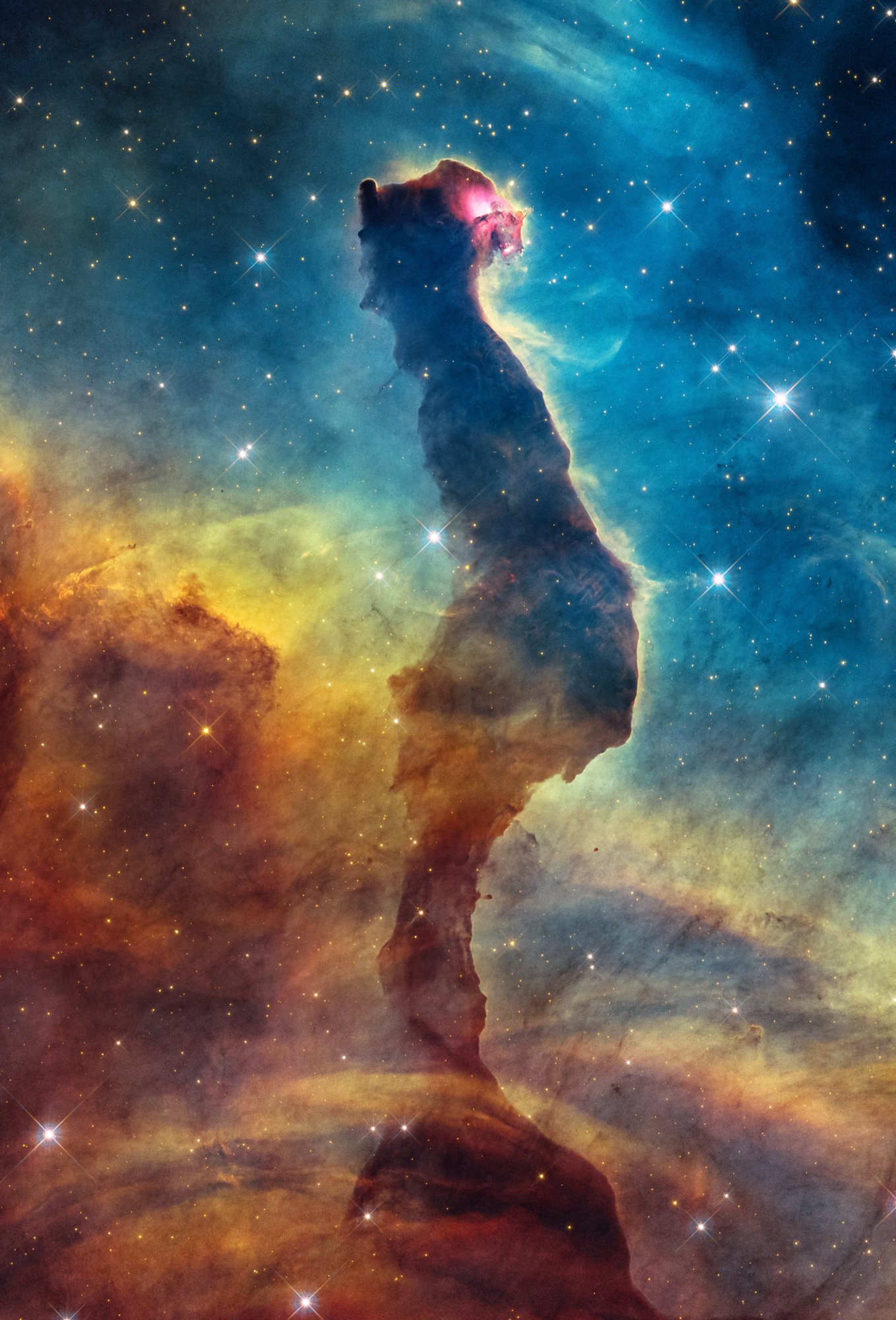
Hubble image of the Cat's Head Nebula: a dark pillar of dust rising through blue and gold glowing gas, its top shaped like a cat's head with a glowing pink-red eye
Hubble WFC3 · visible light
By Telescope Advisor Editorial Team Published: Updated: Reviewed & approved by Juhi Sahni, Senior Editor Editorial Standards
Elena Reyes — Senior Science Editor

Elena Reyes

Senior Science Editor

Covers NASA missions, space science discoveries, and astronomical events for Telescope Advisor. Translates complex astrophysical research into practical insights for backyard observers. Based in the San Francisco Bay Area.

Content reviewed by our editorial team. Research and drafting assisted by AI to ensure unbiased, data-driven analysis. Learn more about our editorial process.

The Short Version

  • What: the Cat's Head Nebula is the nickname for a tall pillar of gas and dust in the Carina Nebula, about 7,500 light-years away. Its silhouette looks like a cat sitting with its back to us.
  • The eye: a bright spot near the top of the pillar may be a young star still wrapped in dust.
  • Three views: Hubble photographed it in visible light in January 2026; Webb followed in May 2026 with both its near-infrared (NIRCam) and mid-infrared (MIRI) cameras. NASA published all three on October 29.
  • Not a stranger: astronomers already knew this pillar. A 2010 Hubble survey caught a 6.5-light-year-long jet, HH 903, bursting out of its sides.
  • Can you see it? The cat itself is a job for a long-focal-length camera. The Carina Nebula around it is a naked-eye showpiece, but only from the Southern Hemisphere or the far south of the US.

01 Interactive

Explore the Cat's Head Nebula in Three Kinds of Light

Switch between Hubble's visible-light view and Webb's two infrared views. Tap a numbered marker to see what you're looking at, or tap the image to open it full screen.

Wavelengths covered by each camera's filters on a log scale. The rainbow strip on the left is the light your eyes can see.

Full Hubble WFC3 view of the Cat's Head Nebula: a dark brown column of dust running from the bottom of the frame to a cat-shaped head near the top, edged with yellow light on its right side, surrounded by cyan and blue gas above and orange and red clouds below, with scattered stars
The Cat's Head Nebula in visible light (Hubble WFC3) — The pillar is so thick with dust that it blocks the glowing gas behind it. Follow the dark column up to the "head" and you'll find the red spot NASA identifies as the cat's eye, possibly a young star. The frame covers about 2.4 arcminutes, roughly 5.5 light-years at Carina's distance. Credit: NASA, ESA, STScI; Image Processing: Joseph DePasquale (STScI).
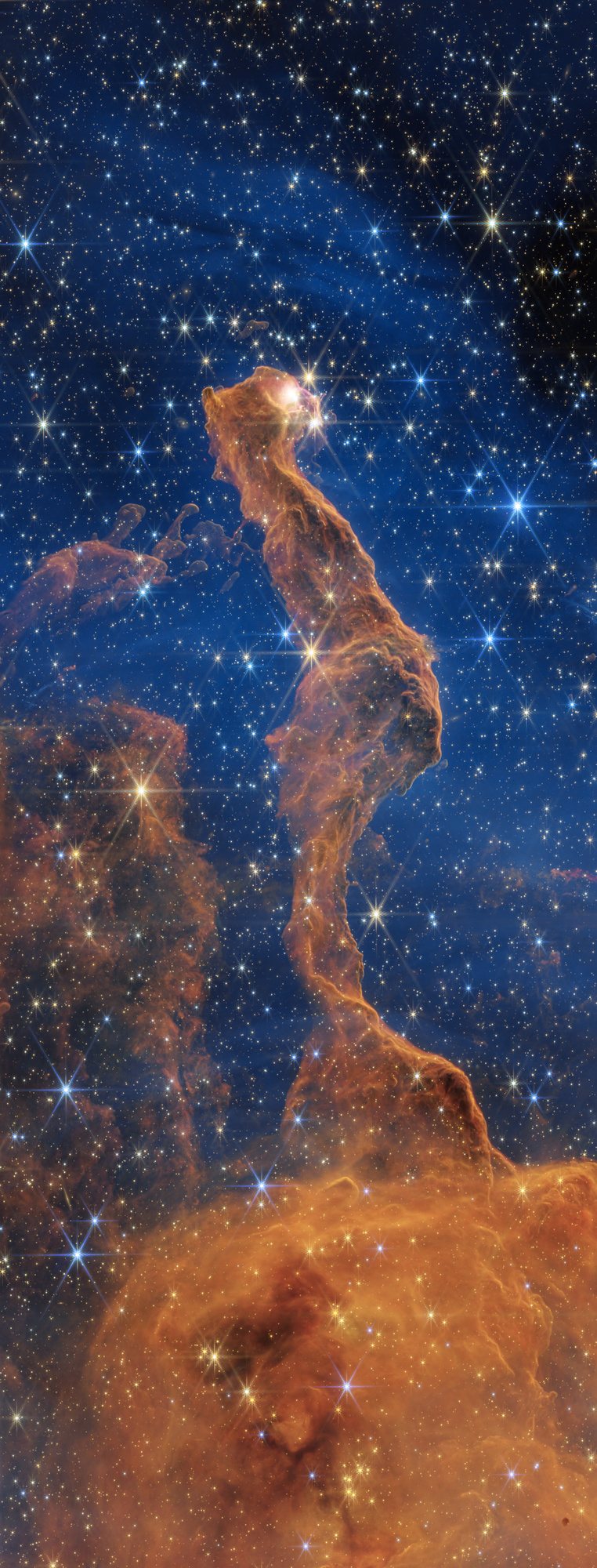
Webb NIRCam near-infrared image of the Cat's Head Nebula: a tall orange pillar with a yellow glowing point at its head, set against a deep blue background crowded with stars, with an orange cloud at the bottom of the frame
The Cat's Head Nebula in near-infrared light (Webb NIRCam) — In near-infrared light the dark silhouette becomes a textured, partly transparent column, the sky fills with stars and the cat's eye turns yellow. The frame is about 2.3 arcminutes across. Credit: NASA, ESA, CSA, STScI; Image Processing: Joseph DePasquale (STScI).
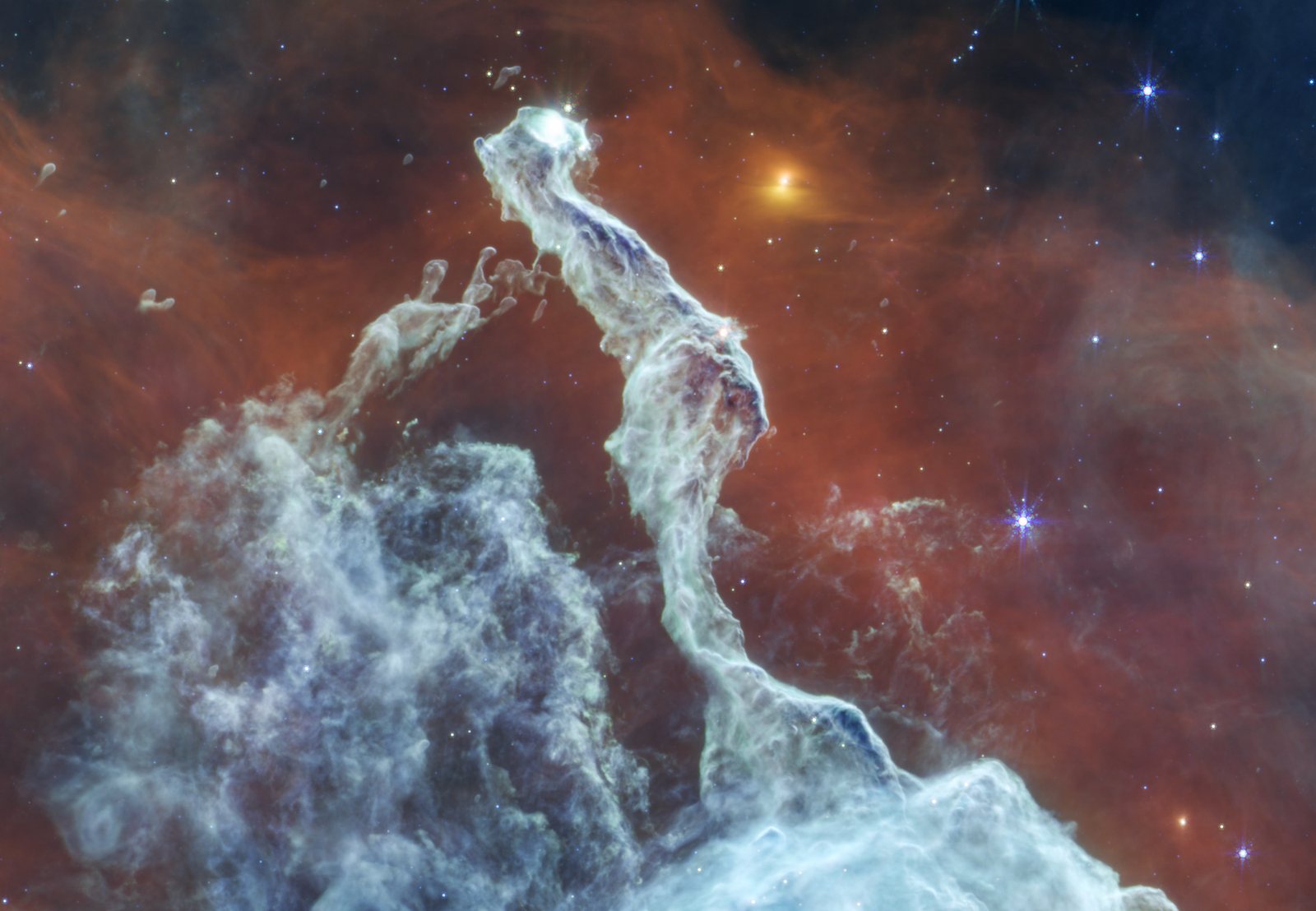
Webb MIRI mid-infrared image of the Cat's Head Nebula: a pale grey-blue pillar rising from a large billowing cloud at lower left, set against rusty red emission, with a bright orange-yellow point of light to the right of the pillar's head and scattered blue stars
The Cat's Head Nebula in mid-infrared light (Webb MIRI) — MIRI's wider frame (about 5.3 arcminutes, or 12 light-years) shows the pillar rising from a much larger cloud. The bright orange-yellow source to the right of the head is probably another young star still buried in dust. Credit: NASA, ESA, CSA, STScI; Image Processing: Joseph DePasquale (STScI).

What you're seeing

  1. The eye. A bright red spot that may be a young star still partly buried in the dust.
  2. Head and ears. The pillar widens into a rounded head turned to the right, with small points where you'd expect ears.
  3. Glowing rim. Hazy yellow light along the right edge, where ultraviolet light from massive stars heats the surface and boils gas away.
  4. The body. An opaque column of dust dense enough to block the light behind it.
  5. Glowing gas. Blue and cyan light from gas energized by nearby stars, mixed with starlight scattered by dust.
  6. Arcs below. Curved bands of material that may have been shaped by radiation and stellar winds.

02 Location

Where the Cat Lives in the Carina Nebula

The Carina Nebula is one of the biggest and brightest star factories in our part of the Milky Way. It sprawls across about two degrees of the southern sky, four times the width of the full Moon, and it's home to Eta Carinae, a star system so luminous that it dominates everything around it, plus clusters of other hot, massive stars such as Trumpler 14 and Trumpler 16. We covered another of its residents in August, when Webb photographed the "Treasure Chest" globule.

The cat is a tiny piece of that landscape. Using the coordinates NASA published (right ascension 10h 46m 00s, declination −60° 06′ 24″), we worked out that it sits about 26 arcminutes south-southeast of Eta Carinae, a little less than a full Moon's width away on the sky. At Carina's distance, that's roughly 57 light-years in projection. This puts the cat in the area astronomers call the South Pillars, a field of dusty columns that all lean back toward Eta Carinae and its neighbours.

Where the Cat's Head Nebula sits relative to Eta Carinae Sky chart, north up and east left. Eta Carinae is near the top centre; the Cat's Head Nebula lies 26 arcminutes to the south-southeast; the Trumpler 14 cluster lies to the north-west of Eta Carinae. A circle the size of the full Moon is drawn to scale for comparison. N E 26′ ≈ 57 light-years Trumpler 14 Eta Carinae Cat's Head Nebula South Pillars Full Moon (to scale)
Positions computed by Telescope Advisor from published J2000 coordinates (north up, east left, as on a sky chart). The coloured glow is illustrative, not a map of the nebula.

The resemblance is easiest to see in the Hubble image. The long dark column is the cat's body, viewed from behind. Near the top, the column widens into a rounded head turned to the right, with small points at the top where you'd expect ears. On the right side of the head, a bright reddish spot plays the part of an eye.

Distance note: NASA's release gives about 7,500 light-years, and its image pages give a range of 7,500 to 8,500 light-years. The figure most often used for Carina, 2,300 parsecs (about 7,500 light-years), comes from measuring how fast the Homunculus cloud around Eta Carinae is expanding.

~7,500 lyDistance to the Carina Nebula
26′Separation from Eta Carinae on the sky, just under a full Moon
~5.5 lyWidth of Hubble's 2.4-arcminute frame
~6.5 lyEnd-to-end length of the HH 903 jet
3 camerasHubble WFC3, Webb NIRCam and Webb MIRI
132 daysBetween Hubble's view (Jan 15) and Webb's (May 27, 2026)

03 Visible light

Hubble's View: A Black Cat With a Burning Edge

In visible light, the pillar is opaque. Its dust soaks up the light of everything behind it, so the cat appears as a dark brown cut-out against the glowing nebula. That darkness is a clue to what the pillar is: a knot of material far denser than its surroundings, dense enough to survive while everything around it is being blown away.

The right-hand edge tells the rest of the story. A thin yellow fringe runs along that side. This is the pillar's skin being heated by ultraviolet light from the massive stars nearby. The radiation strips electrons from atoms at the surface, the heated gas glows, and some of it boils off into space. Astronomers call this photoevaporation, and it's the main way pillars like this one wear down.

The colours around the cat come from Hubble's filters. Several of them isolate light from particular elements: oxygen, hydrogen and sulfur, each glowing at its own wavelength. Others record the broad glow of starlight bouncing off dust. The result shades from blue and cyan above the cat to gold, orange and red below it, a map of where the gas is hotter or cooler, thicker or thinner, and how brightly it is lit.

🔍 Find the rim and the eye in the explorer

04 Infrared

Webb's View: Seeing Into the Cat

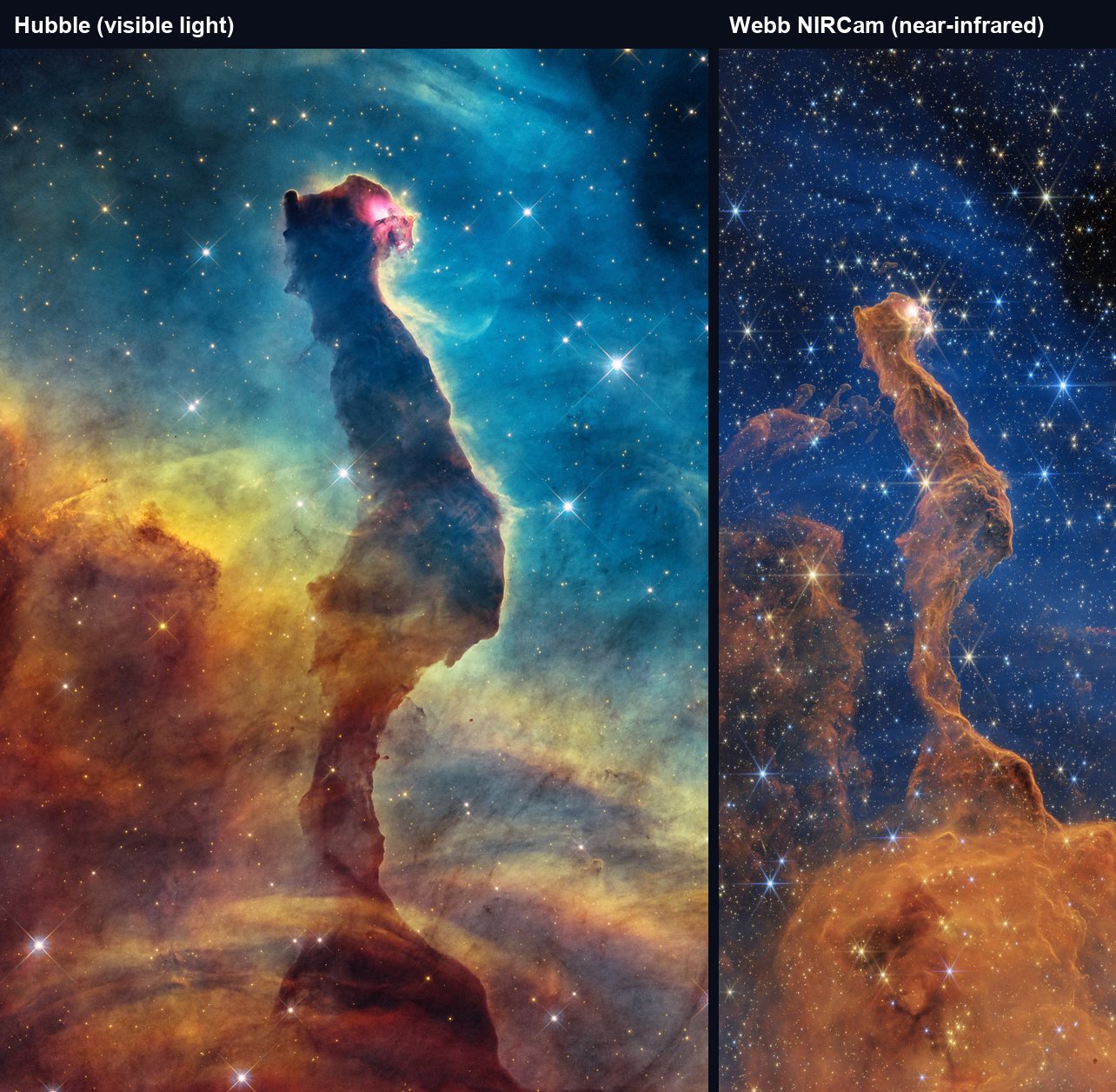
Infrared light travels through dust far more easily than visible light, and Webb looked at the cat in two infrared bands. The difference is clearest side by side.

Side-by-side comparison of the Cat's Head Nebula: on the left, Hubble's visible-light image with a dark opaque pillar; on the right, Webb's NIRCam near-infrared image where the same pillar looks orange and partly see-through against a dark blue sky packed with stars
Hubble (left) vs Webb NIRCam (right) — Both frames cover nearly the same patch of sky (about 2.4 and 2.3 arcminutes across). In near-infrared light the dark silhouette becomes a textured, partly transparent column and the cat's eye turns yellow. Comparison assembled by Telescope Advisor from the two NASA images. Credit: NASA, ESA, CSA, STScI; Image Processing: Joseph DePasquale (STScI).

Near-infrared (NIRCam): the pillar turns translucent

The cat keeps its shape, but the opaque black becomes a glowing orange column whose wrinkled surface you can actually make out. The sky behind fills with stars, shown in blue and yellow, far more than Hubble could see. Some of them still look reddened because they're partly hidden by dust. Look carefully and you'll find faint smudges that aren't stars at all: galaxies far beyond the Milky Way, visible straight through the nebula. The eye is still there, now a yellow point, and on the cat's left a set of thin, ghostly streamers appears, shredded bits of gas and dust exposed to the full force of the nearby stars.

🔍 Open the NIRCam view

Mid-infrared (MIRI): the glow of warm dust

At longer wavelengths the picture changes again. Now the light comes from the material itself: dust warmed by starlight, and carbon-rich molecules (the soot-like compounds astronomers call PAHs) that light up when ultraviolet photons hit them. The cat and the cloud beneath it turn a pale, smoky grey-blue, and the delicate knots and strands on the left side stand out more clearly than in any other view. Differences in colour and brightness trace changes in how warm the material is and what it's made of.

MIRI also picks out a bright source just to the right of the pillar, likely a young star hidden in its own dust cocoon. A thin filament seems to cross in front of it. NASA is careful to say that a single image can't tell us whether the two are actually connected or simply line up by chance.

🔍 Open the MIRI view

Why three images instead of one?

Each wavelength answers a different question. Visible light (Hubble) shows where the pillar's surface is being heated and eroded right now. Near-infrared (NIRCam) shows the stars, including young ones partly hidden in the dust. Mid-infrared (MIRI) shows the dust and molecules themselves. Put together, they let astronomers follow star formation from the outside of the cloud to the inside.

Want the background? Our Hubble vs Webb vs Roman explainer covers what each observatory does best.

05 The backstory

The Jet Astronomers Found in 2010

The nickname is new, but the pillar isn't. NASA's image pages list HH 903 among its names. The "HH" stands for Herbig-Haro, the name for glowing knots of gas made when a newborn star fires narrow jets out of its poles and they slam into the surrounding cloud.

HH 903 was catalogued in a 2010 Hubble survey of jets across the Carina Nebula by Nathan Smith, John Bally and Nolan Walborn (published in Monthly Notices of the Royal Astronomical Society; arXiv:1002.4898). They described it as one of the region's most remarkable outflows: a two-sided jet bursting east and west out of the sides of a large dust pillar, roughly at right angles to it, with a big bow shock at each end. End to end it measures about 2 parsecs (around 6.5 light-years), which put it among the longest jets from a forming star then known.

Two details from that paper make the new images more interesting. First, the authors placed the jet's source about halfway down the pillar, not at the top. Second, they noted that this pillar is the narrow upper end of a far bigger structure, the so-called Giant Pillar, which they called the biggest concentration of molecular gas in the area. In other words, the cat is the tip of a much larger reservoir of star-making material.

Schematic of the HH 903 jet A simplified drawing of a vertical dust pillar with a two-sided jet leaving its sides halfway down and a bow shock at each end. Not to scale. eye? (not linked) source ~halfway down bow shock bow shock HH 903: a two-sided jet ~2 parsecs (6.5 ly) end to end
Simplified schematic based on Smith, Bally & Walborn (2010). Not to scale; orientation simplified.

Is the cat's eye the star powering the jet? Nobody has said so. NASA's release doesn't connect the eye to HH 903, and the 2010 paper put the jet's source mid-pillar rather than in the head. We'll update this article if follow-up work links them.

06 The science

Why Pillars Like This Form, and Why They Vanish

Imagine a sandbar in a strong current. The water carries off loose sand but flows around the denser lumps, leaving them standing as ridges. Something similar happens in a star-forming nebula. Once massive stars switch on, their ultraviolet light and fast winds sweep through the surrounding cloud. The thin gas is cleared away quickly; the thickest clumps hold out longer and are stretched into columns that point back at the stars doing the damage.

1. A lumpy cloud

A giant cloud of gas and dust, denser in some places than others.

2. Sculpted by starlight

Massive stars switch on and blow away the thin gas; dense clumps survive as pillars.

3. The pillar fades

Over a few million years the pillar erodes away, leaving the stars that formed inside it.

The Cat's Head is one of those survivors, and its odd shape is simply a record of where the cloud was dense and where it wasn't. The same process carved the famous Pillars of Creation in the Eagle Nebula and the "Mystic Mountain" elsewhere in Carina (our guide to what a nebula is covers the different types).

Pillars are also where a lot of star birth happens. Squeezing the cloud from outside can push its densest pockets over the edge into collapse, and young stars like the one that may form the cat's eye are often found in them. But it's a race. Every year the pillar loses a little more material to the radiation outside, and once stars switch on inside, they erode it from within too. Over a few million years the cat will be gone, and what remains will be the stars it made.

07 The data

The Observations at a Glance

ImageInstrument & dateFiltersField of view
● Visible lightHubble WFC3/UVIS, January 15, 2026 (program 18206, PI C. Britt)F475W, F502N, F657N, F673N, F814W2.4′ (~5.5 light-years)
● Near-infraredWebb NIRCam, May 27, 2026 (program 12591, PI M. García Marín)F090W, F187N, F212N, F277W, F335M, F470N~2.3′ (~5.4 light-years)
● Mid-infraredWebb MIRI, May 27, 2026 (program 12591)F770W, F1130W, F1500W~5.3′ (~12.3 light-years)

For the technically minded: the narrowband Hubble filters isolate doubly ionized oxygen (F502N), hydrogen-alpha (F657N) and ionized sulfur (F673N). Among Webb's, F187N picks out hydrogen and F212N and F470N trace molecular hydrogen, while F335M, F770W and F1130W sit on the main emission bands of the carbon-rich PAH molecules. Coordinates: RA 10h 45m 59.8s, Dec −60° 06′ 24″ (J2000), in the constellation Carina. All three images were processed by Joseph DePasquale at the Space Telescope Science Institute.

08 For observers

What This Means for Amateur Astronomers: Finding the Cat's Home

Let's be straight about it: you won't see a cat in the eyepiece. The pillar is only about two arcminutes long and sits inside a very bright nebula, and we couldn't find reliable reports of anyone picking out this particular pillar visually. But the Carina Nebula around it is one of the finest sights in the entire sky, visible to the naked eye from a dark site and spectacular in binoculars. The catch is your latitude.

Can you see it from where you live?

Pick a city or drag the slider to your latitude.

64°
highest point above the southern horizon
Never sets

From this latitude the Cat's Head never sets, and it climbs to about 64° high. Best in February to May evenings.

Calculated from the Cat's Head's declination (−60.1°), ignoring atmospheric refraction and terrain. Anything below about 10° is hard to see through haze.

Who can see it, and when

The cat sits at declination −60°, far down in the southern sky. We calculated its height above the horizon from the published position for a range of cities:

Where you areLate Oct – Nov 2026Best season
Sydney, Cape Town, Auckland (~34–37°S)Never sets. Low in the south in the evening, climbing to roughly 35–55° before dawnFebruary to May, 40–60°+ high in the evening
Santiago, Buenos Aires (~34°S)Never sets; about 30–45° up before dawnFebruary to May evenings
Puerto Rico (18°N)By late November it clears the horizon before dawn, a few degrees upFebruary to March around midnight, peaking near 11°
Hawaii (21°N)Not yet; it rises around dawnFebruary to March around midnight, peaking near 9°
Florida Keys, south Texas (~25–26°N)NoAround midnight in February and March, only about 4–5° high; needs a flat southern horizon
Most of the US, Canada, EuropeNoNever rises

To find it, look between the brilliant star Canopus and the Southern Cross: the nebula is the brightest knot in that stretch of the Milky Way. A planetarium app such as those in our best astronomy apps guide will take you straight to it.

What you'll see visually

  • Naked eye: a bright, irregular glow in the Milky Way, wider than the full Moon.
  • Binoculars (7×50 or 10×50): the whole nebula in one view, split by dark lanes, with Eta Carinae as an orange star near the centre. See our best binoculars for stargazing.
  • Small to medium telescope: the dark Keyhole near Eta Carinae, the clusters Trumpler 14 and 16, and a nebula that fills the eyepiece. A UHC or O-III filter boosts contrast, especially from the suburbs.
  • Where to look for the cat: about half a Moon's width south of Eta Carinae. In a large telescope the southern part of the nebula shows dark lanes and notches; the pillars are there, but at this scale they're a test of sky and eyesight.

Photographing it: how big will the cat be?

The camera is where you have a real chance. Using each telescope's focal length and sensor pixel size, this is roughly how many pixels the 2.4-arcminute Hubble frame would cover:

SetupImage scaleHubble frame
Seestar S30 Pro (160mm, IMX585)3.7″/px~40 px
Dwarf 3 (150mm, IMX678)2.8″/px~50 px
Vespera Pro 2 (245mm, IMX676)1.7″/px~85 px
Celestron Origin (335mm, IMX678)1.2″/px~115 px
~1,000mm telescope + 3.76µm camera0.8″/px~185 px

A smart telescope will capture the whole Carina Nebula beautifully, with the cat as a small dark sliver in the south. To make out its shape, you need around a metre of focal length, steady skies and narrowband filters; our narrowband filter guide covers the hydrogen, oxygen and sulfur filters that mirror Hubble's. Southern-hemisphere readers comparing smart scopes can start with our smart telescope comparison.

In the Northern Hemisphere? Try these instead

The Orion Nebula (M42) is the northern sky's answer to Carina: a bright star factory carved by hot young stars, rising in the east by late evening now and getting better every week into winter. For dark shapes against glowing gas, the Lagoon Nebula (M8) returns to the evening sky next summer. And if you're out this weekend, our Halloween night sky guide has what to look for on October 31. For gear, see the best telescopes for nebula viewing.

09 Questions

Frequently Asked Questions

What is the Cat's Head Nebula?

The Cat's Head Nebula is a nickname for a pillar of cold gas and dust inside the Carina Nebula (NGC 3372), about 7,500 light-years away in the southern constellation Carina. Seen from the side, its outline resembles a cat sitting with its back to us and its head turned to the right. NASA released Hubble and Webb images of it on October 29, 2026.

Why does the Cat's Head Nebula have a glowing eye?

The bright spot that forms the cat's eye may be a young star still partly buried in the dust of the pillar. It shows as red in Hubble's visible-light image and yellow in Webb's near-infrared image. NASA describes this as a possibility, not a confirmed identification.

Where is the Cat's Head Nebula?

It lies in the southern part of the Carina Nebula, at right ascension 10h 46m and declination -60 degrees 06 arcminutes. That puts it about 26 arcminutes, a little less than the width of a full Moon, south of the famous star Eta Carinae, in the region astronomers call the South Pillars.

What is HH 903?

HH 903 is a Herbig-Haro object, a jet of gas blasted out by a forming star. A 2010 Hubble survey of the Carina Nebula by Nathan Smith, John Bally and Nolan Walborn found it shooting out from both sides of this pillar, and NASA lists HH 903 among the object names for the new images. The survey measured the flow at about 2 parsecs (roughly 6.5 light-years) from end to end.

What is the difference between the Hubble and Webb images?

Hubble sees visible light, so the pillar appears as a dark silhouette with a bright rim where ultraviolet light from massive stars is heating its surface. Webb's NIRCam sees near-infrared light, which passes through more of the dust and shows the pillar's surface texture, many more stars and even background galaxies. Webb's MIRI sees mid-infrared light, which shows the glow of warm dust and carbon-rich molecules.

Can I see the Cat's Head Nebula with a telescope?

Not as a cat. The pillar is only about 2 arcminutes long and sits inside a very bright nebula, so it is a target for long-focal-length astrophotography rather than visual observing. You can easily see the Carina Nebula around it with your eyes, binoculars or any telescope, but only from the Southern Hemisphere or the far south of the Northern Hemisphere.

Can you see the Carina Nebula from the United States?

Only from the far south. From Hawaii it reaches about 9 degrees above the southern horizon, from Puerto Rico about 11 degrees and from the Florida Keys about 5 degrees, best around midnight from February to March. It never rises for most of the continental United States.

When is the best time to see the Carina Nebula?

From the Southern Hemisphere, February to May, when it is high in the evening sky. In late October and November it is low in the south during the evening and climbs to roughly 35 to 55 degrees before dawn from cities such as Sydney, Cape Town and Auckland, where it never sets.

Will the Cat's Head Nebula last forever?

No. Radiation and winds from the massive stars of the Carina Nebula are slowly eating the pillar away. The densest parts survive longest, and stars forming inside will add their own radiation. Over a few million years the cat shape will be gone, leaving behind the stars that formed inside it.

Sources


Continue Exploring

Keep the session going with the next useful answer

Choose the next page based on whether you need a recommendation, a comparison, or a practical observing plan.

Use Finder Tool →

🎄 Holiday season: Telescope Christmas Gift Guide 2026 · Black Friday deal tracking

More Webb, Hubble & Nebula Stories